


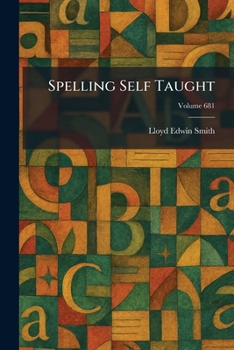
Spelling Self Taught

"Spelling Self Taught" is an instructional guide designed to help individuals master the intricacies of English orthography through independent study. This practical manual provides a systematic exploration of spelling rules, common phonetic patterns, and the various exceptions that often complicate written communication. By breaking down complex linguistic concepts into manageable lessons, the work serves as an essential tool for those looking to improve their literacy and professional writing standards.
The text focuses on identifying and correcting frequent spelling errors, offering readers reliable strategies and mnemonic devices to reinforce their learning. Authored by Lloyd E. Smith, the book emphasizes the importance of accuracy in written expression and provides a foundation for lifelong linguistic development. Whether used as a reference for specific spelling challenges or as a comprehensive course for self-improvement, "Spelling Self Taught" remains a classic example of accessible educational literature aimed at empowering the general reader with the fundamental skills of the English language.
This work has been selected by scholars as being culturally important, and is part of the knowledge base of civilization as we know it. This work was reproduced from the original artifact, and remains as true to the original work as possible. Therefore, you may see the original copyright references, library stamps (as most of these works have been housed in our most important libraries around the world), and other notations in the work.
This work is in the public domain in the United States of America, and possibly other nations. Within the United States, you may freely copy and distribute this work, as no entity (individual or corporate) has a copyright on the body of the work.
As a reproduction of a historical artifact, this work may contain missing or blurred pages, poor pictures, errant marks, etc. Scholars believe, and we concur, that this work is important enough to be preserved, reproduced, and made generally available to the public. We appreciate your support of the preservation process, and thank you for being an important part of keeping this knowledge alive and relevant.
Customer Reviews
ThriftBooks ® and the ThriftBooks ® logo are registered trademarks of Thrift Books Global, LLC
