


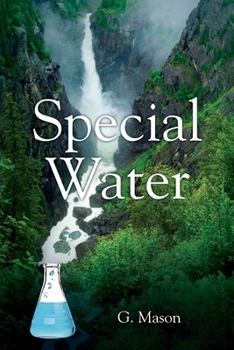
Special Water

On a summer day in 1934, Lars hopped on his bicycle and pedaled up to the construction site in the gorge by the Rjukan waterfall. He had no idea that he was about to meet a German scientist who would introduce him to a rare and different type of water to be produced in the building going up before their eyes, a strange substance of great interest to physicists.
Lars and his teenage friends could never have foreseen how that special water would become a catalyst in altering the fate of the world. In their wildest dreams they could never have imagined how they and their little Norwegian valley would play a pivotal role in the new science that would determine the outcome of mankind's most calamitous conflict.
The sedate town of Rjukan, in the picturesque Vestfjord Valley, was a fine place to come of age, as was all of Norway, a peaceful nation striving to maintain nonalignment in a polarized world of burgeoning hostility and strife. After the winds of war had shredded her neutrality, the Nordic country became a backwater of German occupation as the titanic armed struggle of World War Two rose to full fury. In that scenic valley lurked the plant producing the special water drop by precious drop, dubbed "heavy water" by nuclear physicists seeking to unlock the power of the atom.
With the Germans in control of production, accumulating sufficient quantity to enable uranium fission was all that stood between Hitler's scientists and a nuclear reactor leading to an atomic bomb-all, that is, except for the Norwegian underground resistance and a brave band of resourceful young commandos dedicated to thwarting the atom-splitting ambitions of the Nazi war machine.
Special Water is the saga of a substance crucial to creation of a nuclear weapon, how the heavy water was made and how it very nearly altered the outcome of the war and the course of human history.
Customer Reviews
ThriftBooks® and the ThriftBooks® logo are registered trademarks of Thrift Books Global, LLC
