


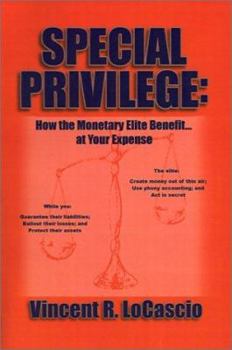
Special Privilege: How the Monetary Elite Benefit at Your Expense


Special Privilege: How the Monetary Elite Benefit at Your Expense, shows how the monetary elite enjoys government-enforced special privileges that violate the cherished principles of both capitalism... This description may be from another edition of this product.
Format:Paperback
Language:English
ISBN:0971038031
ISBN13:9780971038035
Release Date:September 2001
Publisher:Foundation for the Advancement of Monetary Ed
Length:241 Pages
Weight:0.84 lbs.
Dimensions:0.6" x 6.0" x 9.1"
Customer Reviews
3 ratings
This book is excellent but....
Published by Thriftbooks.com User , 20 years ago
This book is excellent, but my newest book, "The Monetary Elite vs. Gold's Honest Discipline" expresses all of the important principles even better and includes developments over the last four years to illustrate my point of view. Furthermore, the new book reflects comments I received from readers over the last four years and incorporates comments from well-known authors on this subject including numerous scholars from Mises.org (Frank Shostak, Christopher Westley, Joseph Salerno, among others), Stephen Roach, Kurt Richebacher, Doug Noland, The Mogambo Guru, Addison Wiggin, and others.
Heads, Money Center Bankers Win; Tails, Taxpayers Lose!
Published by Thriftbooks.com User , 24 years ago
If you think you cannot understand the banking system and how it affects you, give this book a try. Technical terms are avoided. Explanations are made in simple ways. A variety of clear methods are used to illustrate key points. If you already think you know all you need to know about banking, think again. Mr. LoCascio has new observations about old problems that will cause you to stop and think. And hopefully to act!During the worst of the Savings and Loan bailout, the Lesser Developed Country debacles, and commercial real estate collapses of the past 20 years, articles in the financial press repeatedly pointed out that many bankers were playing fast and loose with taxpayer money to take a chance to make it big for themselves, at little personal risk. Today, little is said about this problem. Special Privilege reopens the debate by pointing out that those old problems may be small potatoes compared to what could be ahead for us without fundamental reform in the banking system. Like a lake rapidly filling with gasoline, the potential explosion just keeps growing. Although no one can predict the spark, Mr. LoCascio describes a major stock market collapse as a potential cause.With a title like Special Privilege, you might think this is a liberal view of economics that doesn't reflect the underlying needs of capitalism. Actually, the book attacks the current banking system as being harmful to free markets, holding back capitalism, and undermining our democratic traditions by letting a select group benefit at the expense of everyone else. Special Privilege is the clearest book I have read on the inherent structural weaknesses in the U.S. banking system. These weaknesses are becoming greater as they are pushed to new extremes by decreasingly imprudent bank lending practices, at a time when the banking system is in a very weakened state due to excessive lending to poor credit risks, a national recession, and inappropriate regulation. In the book, you get a good sense of how banking worked (and didn't work) before the current system was established, and how many safety underpinnings have been removed. Like a hereditary group of nobility, money center bankers have been turned loose to compete recklessly for deposits, make bad loans for high fees and interests rates, and degrade the value of the currency safe in the knowledge that the Federal Reserve, the IMF, and the Federal Government will "solve" any problems that crop up. In this system, insolvent lenders are propped up with new loans and banks earn outsized fees for accommodating this. Mr. LoCascio does a good job of describing the special privileges that bankers have available to them, and the harm that is inevitably created as a result. He uses a series of fictional dialogues involving two bankers to help put you inside of the temptation that faces bankers in such a system.The only thing I thought that the book was missing was an explanation of how the U.S. banking system sets up
Monetary perfidy exposed
Published by Thriftbooks.com User , 24 years ago
Regarding peace protesters, Al Haig is reported to have once said, "Let them march all they want, as long as they pay their taxes." Alan Greenspan could well say something similar about the Fed's control over the nation's money -- if, that is, he ever got around to saying anything intelligible at all.In this volume financial planner and consultant Vince LoCascio, following to some degree in Murray Rothbard's footsteps, aims to blow the lid off the "special privilege" of the banking elite. Inspired by Rothbard's _The Mystery of Banking_ and _The Case Against the Fed_, LoCascio seeks to provide the reader with an accessible, easily understood introduction to the sort of jiggery-pokery that currently goes on with our "money."His effort seems to me to be quite successful, though I may not be the best judge of how a reader completely new to the topic would respond to the book. The exposition is set out in clear and intelligible prose and laced with illustrative dialogues. And his proposals for reform are presented cautiously and with due regard for alternative proposals (LoCascio's own is to freeze the money supply at its current level).The "special privilege" of the title is sixfold. Under current U.S. law, banks have six "special privileges" that grant them sweeping and pretty scary powers: the power to create money out of thin air (both by the Fed's initial creation of unbacked currency and through individual banks' pyramiding new money on top of it through the "fractional reserve" system); special protection of their assets (any bank whatsoever can be "rescued" whenever the Fed chooses to do so); liability protection (FDIC deposit guarantees that encourage banks to engage in rash speculation); bailout schemes (at taxpayer expense, of course); funny accounting (e.g. booking outstanding loans at their original value instead of at their current value); and secrecy (banks don't have to report certain information even to their stockholders, let alone to the public). Each of these topics gets a chapter-long workout, and LoCascio does a good job of making them clear.Moreover, his discussion of how things got this way is based in large measure on Milton Friedman's/Anna Jacobson Schwartz's _Monetary History of the United States_, a fine work highly regarded even by non-monetarists (even some Austrians like it). I would have liked to see a reference to Ludwig von Mises in here somewhere, even if just a nod to his _Theory of Money and Credit_, but at any rate LoCascio has selected good sources.Another feature worth noting is LoCascio's insistence that banks' special privileges are a _moral_ problem -- that lending out multiples of demand deposits is a kind of fraud. (This feature has its good and bad points; on the one hand, it's nice to see the ethical question raised, but on the other hand I'm not sure LoCascio adequately explains _why_ it's wrong.)On the whole LoCascio's presentation is thorough and even gripping, and he has a knack for grabbing the reade
Copyright © 2026 Thriftbooks.com Terms of Use
| Privacy Policy | Do Not
Sell/Share My Personal Information | Cookie Policy | Cookie Preferences | Accessibility Statement
ThriftBooks® and the ThriftBooks® logo are registered trademarks of Thrift Books Global, LLC
ThriftBooks® and the ThriftBooks® logo are registered trademarks of Thrift Books Global, LLC
