


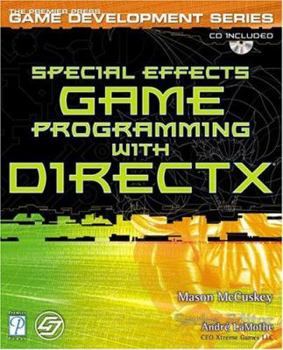
Special Effects Game Programming with DirectX w/CD (The Premier Press Game Development Series)

This book teaches readers everything they will need to know about seventeen awesome effects for game programming; including dynamically generated landscapes, fog, motion blur, and environment mapping.... This description may be from another edition of this product.
Format:Paperback
Language:English
ISBN:1931841063
ISBN13:9781931841061
Release Date:December 2001
Publisher:Muska & Lipman/Premier-Trade
Length:960 Pages
Weight:3.50 lbs.
Dimensions:9.0" x 1.8" x 7.3"
Customer Reviews
4 ratings
Incredible DirectX Coverage
Published by Thriftbooks.com User , 24 years ago
This book makes understanding the complex world of modern computer graphics and the DirectX library as simple as they can be. This title will be an invaluable resource for anyone with a C programming background (or beyond) who wants to become intimitely familiar with the DirectX library for rendering computer graphics. It's heavily slanted towards Windows game programming but the concepts carry over to other domains as well. The book spends time giving background on some of the more useful C++ language features, including stl, utilized in most modern computer games. It also provides an overview of the entire DirectX toolkit: DirectPlay, DirectSound, etc... There's a crash course on the fundamentals of vector/matrix math and basic 3D graphics concepts that are required for a software engineer to really use Direct3D effectively. An experienced C++ graphics programmer can skip over all this and dive right into the advanced graphics features of transform & lighting, pixel and vertex shaders, texture blending effects, etc... The great thing about this title is the way it spends time on motivations and examples so the concepts don't get lost due to their complexity. Simply put if you're a Windows graphics programmer using (or interested in using) DirectX, this book is more than worth its cost!
This book made me want to write my FIRST review!
Published by Thriftbooks.com User , 24 years ago
I've really just started reading this book, but I wanted to write a quick review so as to let others know what they're missing out.The quality and layout of the writing is the best I've seen, especially for beginners I'd probably actually recommend this book over LaMothe's own books. Its better explained and more informitive (as well as being fast and enjoyable). Such as instead of saying "just set it to NULL you don't have to know what it does", McCuskey actually explains what "its" for and why you don't need it (I always liked to know, instead of being left clueless)Its about 900pages of pure content, with little code to break your train of thought (its on the CD). And so far not one sentence is wasted, unlike LaMothe and his comments on what $100K car he drives or how he's some programming "god" by winning a college bet against his peers (what a braggart).It deals with the latest version of DirectX and nVidia SDK. Its very exhaustive on many (if not all) aspects of special effects that you can think of creating. And an unexpected plus to me, was the section on incorporating an intro AVI movie into your game.Don't just listen to me, hurry up and get this book to find out yourself!...btw...am I the only one whose annoyed at that picture of LaMothe on the back cover of all the GD books, where does he think he's in the 'Matrix'?...he seems to take all the credit from rightfully deserving authors, and thats just wrong in my opinion.Though I'm glad he started this series of books.
Mason hits one out of the park
Published by Thriftbooks.com User , 24 years ago
I've been looking forward to this book for a long time now. I've attended several industry conferences with the author, and he's written numerous articles for our website, so I know him to be both an excellent game programmer and talented writer. I had high expectations for this book, and I'm happy to report that it not only lives up to them, it exceeds them.This book does two things very well: it provides first-rate coverage of DirectX, and it provides the most extensive coverage of special effects ever put in to a game programming book. I'm going to review each of these aspects of the book separately.The first half of this book is dedicated to covering the basics of Windows programming, 3D math, and DirectX, and it makes the assumption that you're new to all of these areas. He covers all components of the DirectX API, including DirectAudio, DirectInput, DirectPlay, DirectShow, and of course, DirectGraphics (aka Direct3D), which is where the book really shines. Before this book, I had not encountered a single Direct3D book which I could recommend without reservation. He dedicates 5 hefty chapters to DirectGraphics, including two on texture mapping and one on pixel and vertex shaders (and that doesn't count the second half of the book which provides plenty of examples and advanced techniques). Simply put, this is without question the best book currently on the market from which to learn DirectX, and for that reason alone, it's earned a place at the top of my recommendations list.Note that even if you aren't new to DirectX, you'll probably find a lot of useful things in the first half of the book which are generally omitted from or glossed over in (most) other books, such as action mapping, DirectShow, and DirectPlay. Even the 3D math section has something to offer, with the most concise and accessible explanation of quaternions that I've come across.The special effects section of the book is divided into two parts. The first covers 2D effects, including fire, water, image feedback, image warping, clouds, blurs, and transitions. Before you complain about 2D being a thing of the past, note that these effects are intended for use in title screens, or for generating textures to be used in 3D worlds. The second part is, of course, 3D effects, and includes particle systems, explosions, 3D water, guns and projectiles, lens flares, and vertex and pixel shader effects. All of these are presented quite well, but the particle system coverage deserves special mention. It spans almost 100, and takes you all the way from a basic system to a powerful, flexible system controlled through scripts.Each special effect is accompanied by at least one demo program, which is thoroughly explained in the book. The only downside to this is that the author was only able to focus on a single algorithm for each effect, but he at least mentions some of the alternative approaches, as well as suggestions for improving the techniques he presents. Overall, any game programmer shou
Looks like we have a winner here...
Published by Thriftbooks.com User , 24 years ago
I've been reading through this book for the past few days now and have been pleasantly and repeatedly surprised at the quality and meaningfulness of the writing. Before getting into the style, let's go through what the book covers:Part 1: BasicsChapter 1 - Intro to Windows ProgrammingChapter 2 - Win32 API ProgrammingChapter 3 - DirectXChapter 4 - 3D MathChapter 5 - 3D ConceptsChapter 6 - Intro to DirectGraphicsChapter 7 - LightingChapter 8 - Basic TexturingChapter 9 - Adv. TexturingChapter 10 - Vertex and Pixel ShadersPart 2: 2D EffectsChapter 11 - FireChapter 12 - 2D WaterChapter 13 - Image FeedbackChapter 14 - Image WarpingChapter 15 - CloudsChapter 16 - Blurs and Image Manip.Chapter 17 - Fades, Wipes, Transitions...Part 3: 3D EffectsChapter 18 - Particle Systems: Rain, Smoke, Magic, etcChapter 19 - Adv. Particle SystemsChapter 20 - ExplosionsChapter 21 - Guns and ProjectilesChapter 22 - Lens FlaresChapter 23 - 3D WaterChapter 24 - Vertex and Pixel Shader EffectsThe chapter listing doesn't do the topics justice, though. For example the Chapter on Explosions takes you through sprite animation, billboarding, explosion clusters, particles sytem code, shockwaves and then finishes out with a quick few pages on adding a skybox. The breadth and scope of this book is ambitious - and well met - to say the least.The writing style? In short, you're treated like an intelligent person. McCuskey doesn't delve deeply into a lot of the topics or spend pages on end listing function parameters. Instead you get a box off to the side telling you where in the DirectX documentation to find more information or other sources (books, mags, websites) if you want or need to explore a topic more fully. Likewise, you're not going to find page after page of code listing, just the relevant part at the relevant time. Now that I think of it, the book spends very little real estate on code listings. And it flows much better for it.The benefit from a book like this isn't being told how to program a special effect. The benefit, of course, is finding out how it's done in the first place so you don't spend weeks going down the wrong paths. The solutions seem solid and elegant to me but it'll be interesting to see if anyone finds fault with them.There's not much else to say. It's a well executed book and I haven't found any fault with it. I acknowledge first reviews like these are generally regarded cynically, but I'm sure others will back me up once they receive their copy. Well done, Mason.
Copyright © 2026 Thriftbooks.com Terms of Use
| Privacy Policy | Do Not
Sell/Share My Personal Information | Cookie Policy | Cookie Preferences | Accessibility Statement
ThriftBooks® and the ThriftBooks® logo are registered trademarks of Thrift Books Global, LLC
ThriftBooks® and the ThriftBooks® logo are registered trademarks of Thrift Books Global, LLC
