


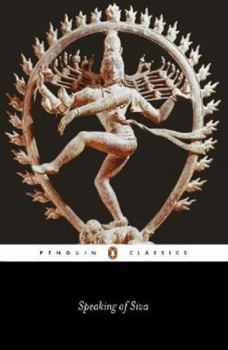
Speaking of Siva

Select Format
Select Condition 
Book Overview
Speaking of Siva is a selection of vacanas or free-verse sayings from the Virasaiva religious movement, dedicated to Siva as the supreme god. Written by four major saints, the greatest exponents of this poetic form, between the tenth and twelfth centuries, they are passionate lyrical expressions of the search for an unpredictable and spontaneous spiritual vision of 'now'. Here, yogic and tantric symbols, riddles and enigmas subvert the language of ordinary experience, as references to night and day, sex and family relationships take on new mystical meanings. These intense poems of personal devotion to a single deity also question traditional belief systems, customs, superstitions, image worship and even moral strictures, in verse that speaks to all men and women regardless of class and caste.
Format:Paperback
Language:English
ISBN:0140442707
ISBN13:9780140442700
Release Date:August 1973
Publisher:Penguin Books
Length:208 Pages
Weight:0.76 lbs.
Dimensions:0.5" x 5.1" x 7.8"
Age Range:18 years and up
Grade Range:Grade 12 and higher
Customer Reviews
5 ratings
Wonderful Sampling of Shiva Poetry
Published by Thriftbooks.com User , 18 years ago
This book became an immediate favorite of mine ever since I picked up a copy of it a couple of years ago. Stunning poems from the Shiva bhakti tradition of India. Basavanna, Devara Dasimayya, Mahadevi, Allama Prabhu. The commentary in the book, though a little academic, is genuinely insightful. Enthusiastically recommended!
Sublime poetry of the ages
Published by Thriftbooks.com User , 18 years ago
This book contains the most moving, personal theistic poetry I have ever read. I re-read it constantly, and have begun buying copies for my close friends. Basavanna and his Virasaiva followers shattered the caste barriers (which do not exist in the Vedas anyhow), and went on to shatter economic and gender barriers. The actions of these saints elaborates their poetry rather than contradicting it. If you don't buy this book, there will be more copies for me.
Fascinating Bhakti poems devoted to Siva
Published by Thriftbooks.com User , 23 years ago
These are fascinating medieval Bhakti poems by four Virasaiva saints, devoted to the Hindu god, Siva, translated from the Kannada language. I am in no position to judge the accuracy of the translation, but they read very well. I should point out that they were not polytheists but monotheists who worshipped God under the form of Siva, just as others, for example, would worship the one god under the form of Vishnu.These four poets, Dasimayya, Basavanna, Allamu, and my favorite, Mahadeviyakka, flourished in the tenth to twelfth centuries. They wrote short poems called vacanas, and according to the translator, A. K. Ramanujan, the are the greatest poets in that tradition. They are a selection of their works, and the identification by a number refers to other editions, and does not imply there are hundreds of poems in this relatively short book.The Bhakti saints often broke away from the Hindu caste system and the elaborate temples and ritual systems in the name of personal relgion. Poem 820 by Basavanna illustrates this perfectly (p. 89):"The rich will make temples for Siva. What shall I, a poor man, do?""My legs are pillars,the body a shrine,the head a cupolaof gold." (820)These four religious poets were devoted to Siva and generally addressed their vacanas to him. They all give particular titles to their universal lord connected with their experience of him. Three of them use titles connected to particular places where they had their conversion experiences. Bassavana addressed his poems to the "lord of the meeting rivers," and Allamu Prabhu to the "Lord of Caves." Devada Desimayya's village had a temple devoted to Ramanatha, Rama's Lord, and he used that. Similarly, Mahadeviyakka called her lord, Cennamallikarjuna, apparently related to the form of Siva worshipped in the temple of her village. Ramnujan translates this as "the Lord White as Jasmine," but points out in his introduction that it can also mean, "Arjuna, Lord of the godess Mallika." (p. 111)The one I find most appealing is the young woman, Mahadeviyakka. She apparently had early devoted herself to Siva, but she was apparently more or less forced into a marriage with a king, which was not successful. She had already regarded herself as married to her "Lord White as Jasmine." Her poems sometimes refer to Siva as her husband and sometimes as her lover, reflecting the conflict.There are stories of her wandering naked, covered with her long hair, to Kalyanna, where Basavanna and Allamu head a school of devotees. Among other things, Allamu asked her about her contradictory behavior, that is, why, since she wears no sari, she then covers herself with the tresses of her hair (no. 183, p. 112-13). "Till the fruit is ripe insidethe skin will not fall off.I'd a feeling it would hurt youIf I displayed the body's seals of love."Anyway, they accepted her as one of their number. It is reported that she later continued her wanderings in search of her Lord. Tradition has it she died fair
Siva, Destroyer of Illusions
Published by Thriftbooks.com User , 26 years ago
This poetry is of the 10th century Bhakti, or devotional yogic tradition, which eschewed academic traditions of prosody and style ("...I don't know anything about meter/ I don't know anything of rhyme/ As nothing will hurt you, My Lord Siva, I'll sing as I love..." one poet writes). The book features excellent translations from Kannada (a Dravidian language), especially of the work of Mahadevi-Akka, a Godiva-like figure who left wealth, marriage, home, and ultimately, her would-be teachers behind to wander naked and homeless in worship of her "Lord White as Jasmine." As the destroyer of illusions, Siva is a purveyor of truth, here found in this devotional poetry.
Unbelievably beautiful poetry
Published by Thriftbooks.com User , 27 years ago
A collection of poems from southern India at about 1200 AD from the Siva cult, these poems range from profound intellectual theology to the loveliest of devotionalism. A find for readers from all traditions.
Copyright © 2026 Thriftbooks.com Terms of Use
| Privacy Policy | Do Not
Sell/Share My Personal Information | Cookie Policy | Cookie Preferences | Accessibility Statement
ThriftBooks® and the ThriftBooks® logo are registered trademarks of Thrift Books Global, LLC
ThriftBooks® and the ThriftBooks® logo are registered trademarks of Thrift Books Global, LLC
