


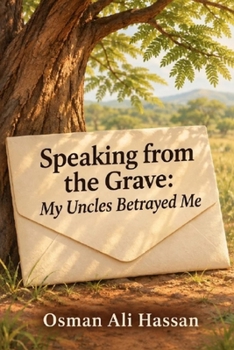
Speaking from the Grave: My Uncles Betrayed Me

What happens when the people a child trusts most become the ones who lead him toward death?
In the dry lands of Somalia, Dhowsane grows up believing that family means protection. His uncles are familiar faces-men he has been taught to respect, trust, and depend upon. To him, the word "uncle" represents safety, guidance, and responsibility.
But as fear, clan tension, and inherited grievances begin to reshape the community around him, that trust is turned against him.
Dhowsane is drawn into a journey with the very men he believes will protect him. He does not understand the danger waiting beyond the familiar paths, nor can he imagine that the adults around him have begun to see his identity as more important than his innocence.
His disappearance leaves behind a grieving family, unanswered questions, and a mother who refuses to accept silence as an answer.
But Dhowsane's story does not end with his death.
From an unmarked grave, his voice becomes a powerful literary symbol for everything violence tried to bury: the truth, the memory of a child, the grief of a family, and the responsibility of those who knew but remained silent.
Speaking from the Grave: My Uncles Betrayed Me is a haunting story of betrayal, family, loss, and the devastating consequences of collective hatred. It explores how ordinary people can surrender their conscience to fear and communal pressure-and how silence can allow injustice to survive.
Yet this is not a story about revenge.
It is a call for truth, individual accountability, remembrance, justice, and reconciliation. Dhowsane does not ask the living to create another grave in his name. He asks them to understand why his grave was created in the first place-and to prevent another child from suffering the same fate.
A powerful and deeply reflective work of fiction, this novel asks a question that reaches far beyond Somalia:
When loyalty demands that we abandon our conscience, what does it mean to remain human?
Customer Reviews
ThriftBooks ® and the ThriftBooks ® logo are registered trademarks of Thrift Books Global, LLC
