


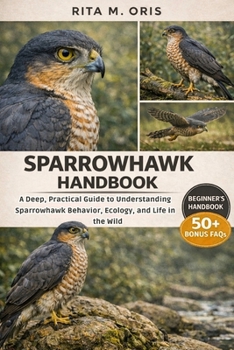
Sparrowhawk Handbook: A Deep, Practical Guide to Understanding Sparrowhawk Behavior, Ecology, and Life in the Wild
No Customer Reviews

Introduction to Sparrowhawks
Sparrowhawks are among the most refined and specialized birds of prey in the natural world, embodying speed, precision, and adaptability in a compact yet formidable form. When people speak of sparrowhawks, they are most often referring to the Eurasian Sparrowhawk, a woodland hawk whose entire existence is shaped by the pursuit of small, fast-moving birds. Unlike larger raptors that dominate open skies and rely on soaring flight, sparrowhawks are hunters of enclosed spaces, thriving in forests, hedgerows, and even urban environments where agility and split-second decision-making mean the difference between success and failure.
At first glance, a sparrowhawk may seem unassuming. Its size is modest, its calls are rarely heard, and it often moves unseen. Yet this quiet presence hides one of the most efficient predatory designs found in birds. Every part of the sparrowhawk's body serves a purpose. Short, rounded wings allow rapid acceleration and tight turns between trees. A long tail acts as a rudder, providing balance and precise control during sudden changes in direction. Sharp talons and a hooked beak ensure that once prey is captured, escape is nearly impossible. These features are not accidental but the result of long evolutionary refinement driven by the demands of hunting alert, evasive prey.
Sparrowhawks occupy a fascinating position in nature because they live so close to people while remaining deeply wild. They are equally at home in ancient woodland and suburban gardens, often hunting near bird feeders where small birds congregate. This closeness has shaped the way people perceive them. For centuries, sparrowhawks were misunderstood and persecuted, blamed for declines in songbird populations. Modern ecological understanding has revealed a very different truth. Sparrowhawks do not destroy bird populations; instead, they play a vital role in maintaining balance by removing weaker or less vigilant individuals. Their presence often signals a healthy ecosystem capable of supporting both predator and prey.
One of the most remarkable features of sparrowhawks is the strong difference between males and females. Females are significantly larger and more powerful, while males are smaller, faster, and more agile. This difference allows each to specialize in different prey sizes, reducing competition within the pair and increasing overall hunting success. The male often focuses on smaller birds, while the female is capable of taking larger prey. This division of roles becomes especially important during the breeding season, when both adults must hunt efficiently to feed their growing chicks.
Behaviorally, sparrowhawks are masters of patience and timing. They may perch silently for long periods, watching and waiting, or launch sudden surprise attacks using cover to remain unseen until the final moment. Their hunting style is often explosive and brief, relying on speed rather than endurance. Success rates are relatively low compared to the number of attempts made, but this is offset by their efficiency and adaptability. Each failed attempt becomes information, refining future hunts through experience and learning.
Historically, sparrowhawks have held a complex place in human culture. They were used in falconry, particularly by beginners, because of their responsiveness and sharp hunting instincts. At the same time, they were heavily targeted by gamekeepers and farmers who viewed them as pests. The use of harmful chemicals in the twentieth century caused serious population declines, but legal protection and environmental recovery allowed sparrowhawks to return to many parts of their former range. Today, they are widely regarded as a conservation success story, demonstrating how wildlife can recover when given protection and space.
Sparrowhawks are among the most refined and specialized birds of prey in the natural world, embodying speed, precision, and adaptability in a compact yet formidable form. When people speak of sparrowhawks, they are most often referring to the Eurasian Sparrowhawk, a woodland hawk whose entire existence is shaped by the pursuit of small, fast-moving birds. Unlike larger raptors that dominate open skies and rely on soaring flight, sparrowhawks are hunters of enclosed spaces, thriving in forests, hedgerows, and even urban environments where agility and split-second decision-making mean the difference between success and failure.
At first glance, a sparrowhawk may seem unassuming. Its size is modest, its calls are rarely heard, and it often moves unseen. Yet this quiet presence hides one of the most efficient predatory designs found in birds. Every part of the sparrowhawk's body serves a purpose. Short, rounded wings allow rapid acceleration and tight turns between trees. A long tail acts as a rudder, providing balance and precise control during sudden changes in direction. Sharp talons and a hooked beak ensure that once prey is captured, escape is nearly impossible. These features are not accidental but the result of long evolutionary refinement driven by the demands of hunting alert, evasive prey.
Sparrowhawks occupy a fascinating position in nature because they live so close to people while remaining deeply wild. They are equally at home in ancient woodland and suburban gardens, often hunting near bird feeders where small birds congregate. This closeness has shaped the way people perceive them. For centuries, sparrowhawks were misunderstood and persecuted, blamed for declines in songbird populations. Modern ecological understanding has revealed a very different truth. Sparrowhawks do not destroy bird populations; instead, they play a vital role in maintaining balance by removing weaker or less vigilant individuals. Their presence often signals a healthy ecosystem capable of supporting both predator and prey.
One of the most remarkable features of sparrowhawks is the strong difference between males and females. Females are significantly larger and more powerful, while males are smaller, faster, and more agile. This difference allows each to specialize in different prey sizes, reducing competition within the pair and increasing overall hunting success. The male often focuses on smaller birds, while the female is capable of taking larger prey. This division of roles becomes especially important during the breeding season, when both adults must hunt efficiently to feed their growing chicks.
Behaviorally, sparrowhawks are masters of patience and timing. They may perch silently for long periods, watching and waiting, or launch sudden surprise attacks using cover to remain unseen until the final moment. Their hunting style is often explosive and brief, relying on speed rather than endurance. Success rates are relatively low compared to the number of attempts made, but this is offset by their efficiency and adaptability. Each failed attempt becomes information, refining future hunts through experience and learning.
Historically, sparrowhawks have held a complex place in human culture. They were used in falconry, particularly by beginners, because of their responsiveness and sharp hunting instincts. At the same time, they were heavily targeted by gamekeepers and farmers who viewed them as pests. The use of harmful chemicals in the twentieth century caused serious population declines, but legal protection and environmental recovery allowed sparrowhawks to return to many parts of their former range. Today, they are widely regarded as a conservation success story, demonstrating how wildlife can recover when given protection and space.
Format:Paperback
Language:English
ISBN:B0GJR2BSP5
ISBN13:9798245282206
Release Date:January 2026
Publisher:Independently Published
Length:140 Pages
Weight:0.43 lbs.
Dimensions:0.3" x 6.0" x 9.0"
Related Subjects
Animals Pets Pets & Animal Care Science Science & Math Science & Scientists Science & TechnologyCustomer Reviews
0 rating
Copyright © 2026 Thriftbooks.com Terms of Use
| Privacy Policy | Do Not
Sell/Share My Personal Information | Cookie Policy | Cookie Preferences | Accessibility Statement
ThriftBooks® and the ThriftBooks® logo are registered trademarks of Thrift Books Global, LLC
ThriftBooks® and the ThriftBooks® logo are registered trademarks of Thrift Books Global, LLC
