


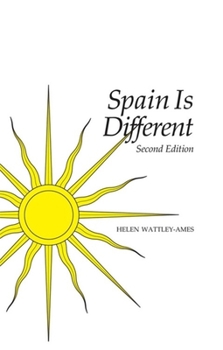
Spain Is Different


Now in an updated second edition
Seven years after the publication of the first edition, Spain is still different, but it is changing, too - modernizing rapidly and participating as an active member of the European Union. While thoroughly updating her original work, Helen Wattley-Ames has maintained her focus in describing the uniqueness of both the Spanish people and their culture and on examining what effect the differences have on the way the Spaniards and Americans relate to and interact with each other. She looks at how Spain has evolved from a travel destination, as source of "sun and cheap wine," to a dynamic modern society. She depicts a people proud of their accomplishments, yet working hard to maintain valued traditions in the face of increased buying power and more European and American influence. The author begins by looking into Spain's past and at critical dimensions of present day American-Spanish relations. She then explores certain aspects of culture important in cross-cultural interactions: society and the individual; relationships; language and communication; work and play. She ends each chapter with an "encounter" - a critical incident that illuminates a situation which may cause misunderstanding, embarrassment or conflict. With extensively updated and revised sections on women (in the workplace in particular), and new sections on minorities and immigrants, and ethics and corruption, the new edition of Spain is Different will be welcomed by anyone looking for clear guidance on how to be most effective in the encounter with the people and culture of Spain.
Seven years after the publication of the first edition, Spain is still different, but it is changing, too - modernizing rapidly and participating as an active member of the European Union. While thoroughly updating her original work, Helen Wattley-Ames has maintained her focus in describing the uniqueness of both the Spanish people and their culture and on examining what effect the differences have on the way the Spaniards and Americans relate to and interact with each other. She looks at how Spain has evolved from a travel destination, as source of "sun and cheap wine," to a dynamic modern society. She depicts a people proud of their accomplishments, yet working hard to maintain valued traditions in the face of increased buying power and more European and American influence. The author begins by looking into Spain's past and at critical dimensions of present day American-Spanish relations. She then explores certain aspects of culture important in cross-cultural interactions: society and the individual; relationships; language and communication; work and play. She ends each chapter with an "encounter" - a critical incident that illuminates a situation which may cause misunderstanding, embarrassment or conflict. With extensively updated and revised sections on women (in the workplace in particular), and new sections on minorities and immigrants, and ethics and corruption, the new edition of Spain is Different will be welcomed by anyone looking for clear guidance on how to be most effective in the encounter with the people and culture of Spain.
Format:Paperback
Language:English
ISBN:1877864714
ISBN13:9781877864711
Release Date:March 1999
Publisher:Nicholas Brealey Publishing
Length:133 Pages
Weight:0.46 lbs.
Dimensions:0.5" x 5.5" x 8.4"
Customer Reviews
1 rating
Different... in spite of it all
Published by Thriftbooks.com User , 24 years ago
This is a very useful book for people with little knowledge of contemporary Spain. In keeping with the goals of the Interact Series, of which it is a volume, "Spain is Different" highlights basic cultural differences between Spain and the United States. (The title refers playfully to a much mocked tourist slogan from the 1960s.) This brief book is not a travel guide, nor does it offer much in terms of historical overview. Wattley-Ames does, however, explain in straight forward fashion basic dynamics of Spanish society that will be unfamiliar to many Americans. Her writing is clear and to the point. (After an introductory chapter that situates Spain in relationship to Europe, Latin America and the United States there follow chapters on Society and the Individual; Relationships; Language and Communication; Work; and, finally, Play.) For example, her four page summary of Spanish family relationships is, with one exception that I'll get to in a moment, right on target. Not only does she situate family life in a broad social context that will be helpful to Americans planning a visit or move to Spain, but she also points out common Spanish feelings about American families: "As for the American habit of moving to the other side of the country or the world without a backward glance, most Spaniards are both envious and dismayed." It's a perceptive and accurate observation. Now, for the exception: in the same section on the family, she has this to say about the thorny issue of child raising in an American-Spanish marriage: "The American is inevitably stricter than the Spaniard about mealtimes, snacks, treats, and naps. Spanish children typically enjoy large quantities of attention and few rules at home." This last sentence is true, but a Spanish parent, especially a mother, may find American eating habits and table manners decidedly lenient. (And as an American married to a Spaniard, well, maybe I'm the exception to Wattley-Ames' rule...) Wattley-Ames' text is judiciously sprinkled with Spanish words and expressions that serve to underscore observations. She is clearly knowledgeable of her subject matter and the book is free of significant errors, although I might quibble with some omissions. (Her discussion of regional languages and linguistic politics, for example, is a little misleading and too brief.) On the other hand, her observations on Spanish social life are particularly astute. Just as importantly, she is well aware of the dangers of generalization and stereotyping, and combats this intelligently by accompanying her observations with appropriate real life examples, proverbs, quotes from respected Spanish observers, etc. Of particular value are the chapter ending "encounters", which provide concrete examples of situations in which an American would benefit from having 'cultural literacy' regarding Spanish customs and behaviors. There is a brief bibliography that includes a valuable section on recent Spanish cinema.
Copyright © 2026 Thriftbooks.com
Terms of Use | Privacy Policy | Do Not Sell/Share My Personal Information | Cookie Policy | Cookie Preferences | Accessibility Statement
ThriftBooks ® and the ThriftBooks ® logo are registered trademarks of Thrift Books Global, LLC
ThriftBooks ® and the ThriftBooks ® logo are registered trademarks of Thrift Books Global, LLC
