


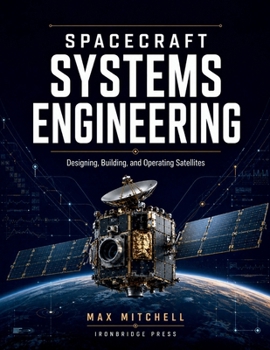
Spacecraft Systems Engineering: Requirements, Architecture, and Verification for Space Missions
No Customer Reviews

In 1958, a small radiation detector rode an early satellite into orbit and came back with readings nobody had expected. What they revealed was not an instrument fault. It was a belt of charged particles, trapped by Earth's magnetic field, wrapped around the planet. Every spacecraft built since has had to survive that environment, and the ones that fail to survive it usually fail quietly: a bit flipped in memory, a solar cell degraded a few percent per year, a surface eroded by atomic oxygen until its optical properties no longer match the thermal model. None of those failures announce themselves. They are budgeted for, years before launch, or they are not survived.
This book teaches spacecraft systems engineering as a set of calculations you can perform yourself: fifty-two complete worked examples, each carried from stated assumptions through every intermediate step and unit to a checked final answer. Sixteen chapters follow one continuous thread. A mission objective becomes a written requirement. The requirement becomes a budget of mass, power, and data. The budget is allocated to subsystems with margin. Every allocation is verified before the vehicle flies. Inside the book: How to choose a shielding thickness against a total-dose requirement, and why shielding does comparatively little against the effects that flip a single bitWhat a spacecraft's thermal cycle count actually reaches over a six-year mission, and what that number does to a mechanismHow to estimate end-of-life solar array power once radiation damage has been accounted forWhy a spacecraft with eight subsystems that each meet their written specification can still fail its missionThe full delta-v arithmetic behind a transfer to geostationary orbit, and the propellant mass it costs in kilogramsHow to close a radio link budget in decibels, and which term to change first when it will not closeThe one question to ask before adding a redundant unit
Every chapter opens with learning objectives, defines its vocabulary where it is first needed, and ends with practice problems and an answer key, so a method can be exercised rather than only read. Written for engineers moving into spacecraft work from another discipline, graduate students who need the numbers behind the block diagrams, and subsystem specialists asked to hold the whole vehicle in view.
This book teaches spacecraft systems engineering as a set of calculations you can perform yourself: fifty-two complete worked examples, each carried from stated assumptions through every intermediate step and unit to a checked final answer. Sixteen chapters follow one continuous thread. A mission objective becomes a written requirement. The requirement becomes a budget of mass, power, and data. The budget is allocated to subsystems with margin. Every allocation is verified before the vehicle flies. Inside the book: How to choose a shielding thickness against a total-dose requirement, and why shielding does comparatively little against the effects that flip a single bitWhat a spacecraft's thermal cycle count actually reaches over a six-year mission, and what that number does to a mechanismHow to estimate end-of-life solar array power once radiation damage has been accounted forWhy a spacecraft with eight subsystems that each meet their written specification can still fail its missionThe full delta-v arithmetic behind a transfer to geostationary orbit, and the propellant mass it costs in kilogramsHow to close a radio link budget in decibels, and which term to change first when it will not closeThe one question to ask before adding a redundant unit
Every chapter opens with learning objectives, defines its vocabulary where it is first needed, and ends with practice problems and an answer key, so a method can be exercised rather than only read. Written for engineers moving into spacecraft work from another discipline, graduate students who need the numbers behind the block diagrams, and subsystem specialists asked to hold the whole vehicle in view.
Format:Paperback
Language:English
ISBN:B0HGYCP8MD
ISBN13:9798170368624
Release Date:August 2026
Publisher:Independently Published
Length:410 Pages
Weight:2.08 lbs.
Dimensions:0.8" x 8.5" x 11.0"
Customer Reviews
0 rating
Copyright © 2026 Thriftbooks.com
Terms of Use | Privacy Policy | Do Not Sell/Share My Personal Information | Cookie Notice | Cookie Preferences | Accessibility Statement
ThriftBooks ® and the ThriftBooks ® logo are registered trademarks of Thrift Books Global, LLC
ThriftBooks ® and the ThriftBooks ® logo are registered trademarks of Thrift Books Global, LLC
