


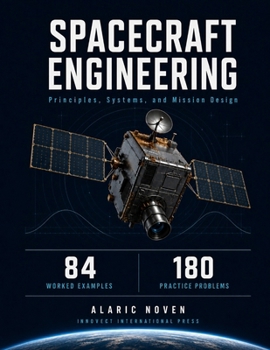
Spacecraft Engineering: Principles, Systems, and Mission Design
No Customer Reviews

A SPACECRAFT IS THE ONLY MACHINE AN ENGINEER WILL EVER BUILD THAT NOBODY CAN REPAIR.
That single fact organises everything else. Because no technician will ever visit, the vehicle must carry its own power plant, its own climate control, its own navigation sense, and its own capacity to detect and survive its faults, all within unforgiving mass, volume, and power ceilings. Yet the subject is usually taught in pieces. Orbital mechanics lives in one course, attitude dynamics in another, power and thermal design in electives, and the discipline that forces them to agree with one another in none at all. The gap appears on the first real design job: you can propagate an orbit and size a solar array, but that same array drags on the residual atmosphere, torques the control system, and lowers the structural frequencies the launch vehicle constrains.
This book teaches the negotiation. Across eighteen chapters it carries one reference mission, a 180-kilogram Earth-observation satellite in a 550-kilometer sun-synchronous orbit, from concept through disposal. Each subsystem chapter sizes one real piece of it and ends in numbers. When a later chapter revises what an earlier chapter estimated, that is not an inconsistency; it is the design spiral working in the open, which is how real programs converge.
Inside you will: Trace requirements from mission objective to subsystem specification and back through verificationBuild and audit the five master budgets, mass, power, data, velocity change, and pointing, with margin policy applied by program phaseSize a propulsion system, close a link budget and an eclipse-season power budget, and reconcile both against the data budgetTurn the space environment into hard requirements: drag, radiation dose, charging, debris flux, vacuum, and ultravioletSequence an environmental test campaign, vibration, acoustic, thermal-vacuum, and electromagnetic compatibility, with pass and fail criteria statedCompute redundancy reliability, build a failure modes and effects analysis, and close an end-of-life disposal caseWork through 84 worked examples that carry their full arithmetic, and 180 practice problems with answer keysCoverage spans the space environment; two-body motion, maneuvers, perturbations, and mission orbits; ground tracks, coverage, and launch windows; requirements, budgets, and margins; then propulsion, attitude determination and control, electrical power, thermal control, structures and mechanisms, communications, command and data handling, flight software, and payloads; and finally integrated mission design, assembly and test, ground segment and operations, reliability, safety, and end-of-life disposal. Three appendices, a glossary, an index, and a consolidated parameter table support reference use.
It is written for upper-level undergraduates, graduate students entering the field, and practising engineers arriving from adjacent disciplines. It assumes calculus through elementary differential equations, university physics, and comfort with vectors, and builds everything else.
Open Chapter 1 and follow one satellite from an idea on paper to a verified, operated, and safely retired vehicle, and learn the negotiation that makes the pieces agree.
That single fact organises everything else. Because no technician will ever visit, the vehicle must carry its own power plant, its own climate control, its own navigation sense, and its own capacity to detect and survive its faults, all within unforgiving mass, volume, and power ceilings. Yet the subject is usually taught in pieces. Orbital mechanics lives in one course, attitude dynamics in another, power and thermal design in electives, and the discipline that forces them to agree with one another in none at all. The gap appears on the first real design job: you can propagate an orbit and size a solar array, but that same array drags on the residual atmosphere, torques the control system, and lowers the structural frequencies the launch vehicle constrains.
This book teaches the negotiation. Across eighteen chapters it carries one reference mission, a 180-kilogram Earth-observation satellite in a 550-kilometer sun-synchronous orbit, from concept through disposal. Each subsystem chapter sizes one real piece of it and ends in numbers. When a later chapter revises what an earlier chapter estimated, that is not an inconsistency; it is the design spiral working in the open, which is how real programs converge.
Inside you will: Trace requirements from mission objective to subsystem specification and back through verificationBuild and audit the five master budgets, mass, power, data, velocity change, and pointing, with margin policy applied by program phaseSize a propulsion system, close a link budget and an eclipse-season power budget, and reconcile both against the data budgetTurn the space environment into hard requirements: drag, radiation dose, charging, debris flux, vacuum, and ultravioletSequence an environmental test campaign, vibration, acoustic, thermal-vacuum, and electromagnetic compatibility, with pass and fail criteria statedCompute redundancy reliability, build a failure modes and effects analysis, and close an end-of-life disposal caseWork through 84 worked examples that carry their full arithmetic, and 180 practice problems with answer keysCoverage spans the space environment; two-body motion, maneuvers, perturbations, and mission orbits; ground tracks, coverage, and launch windows; requirements, budgets, and margins; then propulsion, attitude determination and control, electrical power, thermal control, structures and mechanisms, communications, command and data handling, flight software, and payloads; and finally integrated mission design, assembly and test, ground segment and operations, reliability, safety, and end-of-life disposal. Three appendices, a glossary, an index, and a consolidated parameter table support reference use.
It is written for upper-level undergraduates, graduate students entering the field, and practising engineers arriving from adjacent disciplines. It assumes calculus through elementary differential equations, university physics, and comfort with vectors, and builds everything else.
Open Chapter 1 and follow one satellite from an idea on paper to a verified, operated, and safely retired vehicle, and learn the negotiation that makes the pieces agree.
Format:Paperback
Language:English
ISBN:B0HBLGZYQW
ISBN13:9798188944766
Release Date:July 2026
Publisher:Independently Published
Length:296 Pages
Weight:1.52 lbs.
Dimensions:0.6" x 8.5" x 11.0"
Related Subjects
Engineering Science Science & Math Science & Scientists Science & Technology TechnologyCustomer Reviews
0 rating
Copyright © 2026 Thriftbooks.com
Terms of Use | Privacy Policy | Do Not Sell/Share My Personal Information | Cookie Notice | Cookie Preferences | Accessibility Statement
ThriftBooks ® and the ThriftBooks ® logo are registered trademarks of Thrift Books Global, LLC
ThriftBooks ® and the ThriftBooks ® logo are registered trademarks of Thrift Books Global, LLC
