


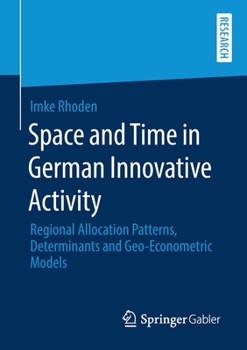
Space and Time in German Innovative Activity: Regional Allocation Patterns, Determinants and Geo-Econometric Models
No Customer Reviews

Three analyses show regional and temporal behavior and determinants of innovation activity in Germany in the timeframe 2000-2016. Techniques as kernel density estimation and geoadditive modeling allow gaining insights into the allocation of innovation economics. On the geographical level of administrative districts innovation and its theory-based determining factors are connected. Estimation methods also add to the explanatory content of the models, partly assisted by the usage of Bayesian prior knowledge. The results allow explicit economic and political consequences and offer possibilities for detailed support of innovation and economic growth. The reflection of the estimated effects back onto regions can increase understanding of the spatial characteristics of innovation.
The Author: Imke Rhoden is research assistant at the chair of Economic Policy 3 at the Ruhr-Universit?t Bochum. Their scientific focus is directed at spatial modeling of innovation and economic growth and applications for economic policy.
The Author: Imke Rhoden is research assistant at the chair of Economic Policy 3 at the Ruhr-Universit?t Bochum. Their scientific focus is directed at spatial modeling of innovation and economic growth and applications for economic policy.
Format:Paperback
Language:English
ISBN:3658285990
ISBN13:9783658285999
Release Date:November 2019
Publisher:Springer Gabler
Length:224 Pages
Weight:0.65 lbs.
Dimensions:0.5" x 5.8" x 8.3"
Customer Reviews
0 rating
Copyright © 2026 Thriftbooks.com Terms of Use
| Privacy Policy | Do Not
Sell/Share My Personal Information | Cookie Policy | Cookie Preferences | Accessibility Statement
ThriftBooks® and the ThriftBooks® logo are registered trademarks of Thrift Books Global, LLC
ThriftBooks® and the ThriftBooks® logo are registered trademarks of Thrift Books Global, LLC
