


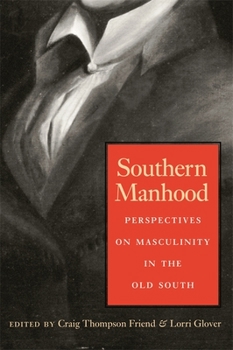
Southern Manhood: Perspectives on Masculinity in the Old South


Select Format
Select Condition 
Book Overview
Spanning the era from the American Revolution to the Civil War, these nine pathbreaking original essays explore the unexpected, competing, or contradictory ways in which southerners made sense of... This description may be from another edition of this product.
Format:Paperback
Language:English
ISBN:082032616X
ISBN13:9780820326160
Release Date:July 2004
Publisher:University of Georgia Press
Length:234 Pages
Weight:0.75 lbs.
Dimensions:0.6" x 6.0" x 8.9"
Customer Reviews
1 rating
southern manhood during one century
Published by Thriftbooks.com User , 21 years ago
The editors stated that analyses of Southern masculinity have focused on upper-class, white men and their honor system. This book tries to break that mode by discussing working-class white men, Choctaw men, and African-American men. Usually, cultural critics and literary critics embrace gender studies, rather than historians. Here, however, historians juggle this ball with positive results. This book cover topics like literacy, slave escapes, humor, unions, military schools, inter alia. The authors are male and female, despite this being a men's studies text. The book strictly covers the post-revolution and pre-Emancipation era. Those looking for a talk on modern Souther masculinity must turn elsewhere. This book does represent the entire South, rather than focusing on one state and assuming that it was representative of all of them. The book states interesting things about Southern, white men. Not only did Southern men purposely differentiate themselves from their Northern counterparts, they also strictly saw themselves as not European. The changing economics of the South is also analyzed, noting how it changed concepts of manhood accordingly. The book is not flawless. The first chapter, "Refuge of Manhood," details how Southern voluntary soldiers distanced themselves from women and African Americans and demanded guns and uniforms. However, these two concepts are never really brought together. The chapter ends up just being a laundry list. In "Fraternity and Masculinity," the author attempts to compare white artisans to black ones. However, she focuses much more on whites than blacks and never once explains why or bothers to note this as a problem. The best chapter is "The Absent Subject: African American Masculinity and Forced Migration." In it, the author says that whites and Northern blacks looked at slaves as fools and eunuchs for not running away or committing suicide. Here, Edward Baptist gives precise details how male slaves often created their sense of manhood by caring for women and children or doing shoddy work on the plantation. They also embraced Christianity, hoping the afterlife would be the promised paradise the Bible suggests. As a black person whose grandparents did not leave the South until the tail end of the Great Migration, I was blown away by this piece. Big applause for Edward E. Baptist. Sometimes the chapters felt like they were all details and little analysis. The chapters are quite short but are well-written. Readers will applaud the contributors because surely this dated information would be hard for any person, even academics, to find.
Copyright © 2026 Thriftbooks.com
Terms of Use | Privacy Policy | Do Not Sell/Share My Personal Information | Cookie Policy | Cookie Preferences | Accessibility Statement
ThriftBooks ® and the ThriftBooks ® logo are registered trademarks of Thrift Books Global, LLC
ThriftBooks ® and the ThriftBooks ® logo are registered trademarks of Thrift Books Global, LLC
