


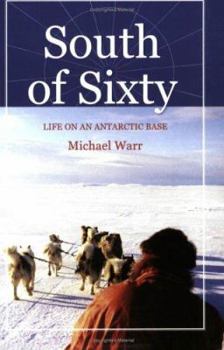
South of Sixty

No Synopsis Available.
Format:Paperback
Language:English
ISBN:097385040X
ISBN13:9780973850406
Release Date:June 2006
Publisher:Antarctic Memories Publishing
Length:174 Pages
Weight:0.58 lbs.
Dimensions:8.5" x 0.5" x 5.5"
Customer Reviews
2 ratings
Warm, engaging memoir
Published by Thriftbooks.com User , 18 years ago
In 1963 20-year-old Michael Warr signed up for a two-year hitch with the British Antarctic Survey as a meteorologist in the Antarctic. He kept a diary. "South of Sixty" is the diary transformed into a most engaging memoir forty years later by the now sixty-year-old Michael Warr. I recently read Charles Darwin's famed "Voyage of the Beagle," and while Warr's account of his adventures is modest compared to that masterpiece, it is nonetheless similar in some respects. They went to some of the same places, Montevideo and the Falkland Islands, for example; and while Warr didn't circumnavigate the globe, he did get a lot colder than Darwin even did! And both men transcribed their notes some years after the event. There is a certain charm in such narratives perhaps because the writer gets to look back at the life of a younger man who was himself. The further similarity that struck me was the love of learning and exploring that both men share. Like Darwin, Warr observes the flora and fauna and takes a delight in what he sees. His interaction with the huskies that pull the sledges, full of warmth and understanding, was one of the highlights of the book. Here's an example of Warr's clean, crisp prose: "In May 1958 three men from the Horseshoe Island base sledged west to the Dions. They were not seen again. Nine of their fourteen huskies made their way back to the Horseshoe Island and the Stonington Island area. The dogs had traveled east for thirty miles over broken sea ice. One of the men, to give the dogs a chance at surviving, had cut their traces." (pp. 111-112) Whenever I read a memoir I can't help but read between the lines, asking myself, what kind of person is the author? What does he think of himself? How candid is he? How much or how little does he try to make himself look good? The magic of this book is that Warr doesn't attempt to make himself out in any way. He lets the words of the 20-year-old that he once was speak for themselves. What comes through is an earnest, likeable, and talented young man learning about the world. His interactions with the other "Fids" at the two bases suggest a young man eager to learn from others and eager to take his place in that unique world of men, a world that was in some respects like being in the army or in the French Foreign Legion or even in prison! Warr adapted so well that when it came time to leave after two years of virtual isolation, he was a bit sorry to go and even wanted to stay longer. Personally I think I would be rabid with cabin fever. Warr describes the penguins, the seals, the flying birds and the few other bits of wild life that he encounters in a way that makes them vibrant. His descriptions of breaking up fights between the huskies, of feeding them and sledging with them read like something from Jack London. There is a sense of being one with the dogs, of sharing their short, harsh existence, and learning from them, that reminds me of the best in nature writing.
COOL!
Published by Thriftbooks.com User , 18 years ago
This is a day-to-day account of life in an Antarctic base in the 1960's. Michael Warr was a meteorologist with the British Antarctic Survey, first on Deception Island, then on Adelaide Island. The author makes no bones about the harshness of life below 60 degrees of latitude; there are scenes of seal-killing that will affect the animal-rights people (they needed seals to feed the dogs; if you can't stand hunting scenes, you won't like this.) The gritty details like cooking, sledging, what plant life you find, is in excellent detail. Then the author takes a tourist trip to Antarctica a few years ago and compares life today versus life in 1963. I really enjoyed this memoir (well, I love memoirs, and travel memoirs especially.) But what I really liked was how the author discussed how he matured from a raw youth, how it was to be young, in a remote, dangerous place and how the Antarctic had changed when he went back as a tourist forty years later. The scene of Briscoe House, abandoned and damaged by volcanic ash, was poignant. The pictures more so. I don't know if I will ever be privileged to go to the South Shetland islands, but if I don't, I can enjoy this tale of an arctic expedition, complete with dogs and funny British customs. This is wonderful reading.
Copyright © 2026 Thriftbooks.com
Terms of Use | Privacy Policy | Do Not Sell/Share My Personal Information | Cookie Policy | Cookie Preferences | Accessibility Statement
ThriftBooks ® and the ThriftBooks ® logo are registered trademarks of Thrift Books Global, LLC
ThriftBooks ® and the ThriftBooks ® logo are registered trademarks of Thrift Books Global, LLC
