


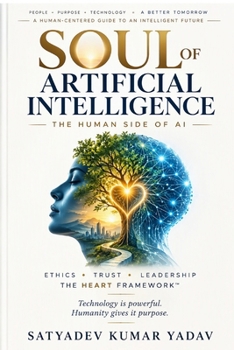
Soul of Artificial Intelligence: The Human Side of Artificial Intelligence: Ethics, Trust, Leadership, and the HEART Framework
No Customer Reviews

Soul of Artificial Intelligence
The Future of AI Is Not About Machines. It Is About Humanity.
What happens when humanity creates intelligence capable of learning, reasoning, creating, and influencing decisions at a scale never before possible?
Artificial Intelligence is rapidly reshaping business, government, education, healthcare, finance, creativity, and daily life yet amid the excitement, one critical question remains: Can humanity create intelligent machines without losing sight of human wisdom?
Soul of Artificial Intelligence is a thought-provoking exploration of the most important challenge of the twenty-first century: ensuring that technological advancement remains aligned with human values.
Rather than focusing only on algorithms, software, and automation, this book examines the deeper questions surrounding trust, ethics, leadership, responsibility, accountability, and the future of human decision-making. Author presents a compelling vision for a future where Artificial Intelligence serves humanity rather than replaces it.
At the heart of the book is the groundbreaking: HEART Framework(TM)- A practical roadmap for responsible AI leadership built on five enduring principles: H - Humanity First- People must remain at the center of technological progress.
E - Ethics by Design- Responsible systems must be designed with integrity from the beginning.
A - Accountability- Every significant AI decision must have human ownership.
R - Reliability- Trustworthy systems require consistency, quality, and continuous validation.
T - Transparency- People deserve meaningful understanding of decisions that affect their lives.
Inside This Book You Will DiscoverHow AI evolved from a tool into a decision-making partnerWhy trust may become the world's most valuable digital assetThe hidden risks behind algorithmic bias, automation, and opaque systemsThe future of work, leadership, and human intelligenceHow organizations can build trustworthy and responsible AIWhy ethics is becoming a competitive advantagePractical frameworks for governing AI in business and societyHow quality assurance principles can help shape safer AI systemsWhy intelligent machines require wiser human leadershipA vision for preserving human dignity in an age of increasingly powerful technologyExplore Powerful Original ConceptsHEART Framework(TM)Trust Assurance(TM)Ethical Intelligence (EI)AI Trust Science(TM)Trust Quotient (TQ)Global AI Trust Index (GATI)Responsible AI Leadership Models
The Future of AI Is Not About Machines. It Is About Humanity.
What happens when humanity creates intelligence capable of learning, reasoning, creating, and influencing decisions at a scale never before possible?
Artificial Intelligence is rapidly reshaping business, government, education, healthcare, finance, creativity, and daily life yet amid the excitement, one critical question remains: Can humanity create intelligent machines without losing sight of human wisdom?
Soul of Artificial Intelligence is a thought-provoking exploration of the most important challenge of the twenty-first century: ensuring that technological advancement remains aligned with human values.
Rather than focusing only on algorithms, software, and automation, this book examines the deeper questions surrounding trust, ethics, leadership, responsibility, accountability, and the future of human decision-making. Author presents a compelling vision for a future where Artificial Intelligence serves humanity rather than replaces it.
At the heart of the book is the groundbreaking: HEART Framework(TM)- A practical roadmap for responsible AI leadership built on five enduring principles: H - Humanity First- People must remain at the center of technological progress.
E - Ethics by Design- Responsible systems must be designed with integrity from the beginning.
A - Accountability- Every significant AI decision must have human ownership.
R - Reliability- Trustworthy systems require consistency, quality, and continuous validation.
T - Transparency- People deserve meaningful understanding of decisions that affect their lives.
Inside This Book You Will DiscoverHow AI evolved from a tool into a decision-making partnerWhy trust may become the world's most valuable digital assetThe hidden risks behind algorithmic bias, automation, and opaque systemsThe future of work, leadership, and human intelligenceHow organizations can build trustworthy and responsible AIWhy ethics is becoming a competitive advantagePractical frameworks for governing AI in business and societyHow quality assurance principles can help shape safer AI systemsWhy intelligent machines require wiser human leadershipA vision for preserving human dignity in an age of increasingly powerful technologyExplore Powerful Original ConceptsHEART Framework(TM)Trust Assurance(TM)Ethical Intelligence (EI)AI Trust Science(TM)Trust Quotient (TQ)Global AI Trust Index (GATI)Responsible AI Leadership Models
These frameworks offer leaders, innovators, policymakers, educators, and professionals' practical tools for navigating the opportunities and responsibilities of the AI era.
This Book Asks the Questions That Will Define the Future
Format:Paperback
Language:English
ISBN:B0HG6G9ZRZ
ISBN13:9798194289332
Release Date:August 2026
Publisher:Independently Published
Length:152 Pages
Weight:0.42 lbs.
Dimensions:0.4" x 6.0" x 9.0"
Customer Reviews
0 rating
Copyright © 2026 Thriftbooks.com
Terms of Use | Privacy Policy | Do Not Sell/Share My Personal Information | Cookie Notice | Cookie Preferences | Accessibility Statement
ThriftBooks ® and the ThriftBooks ® logo are registered trademarks of Thrift Books Global, LLC
ThriftBooks ® and the ThriftBooks ® logo are registered trademarks of Thrift Books Global, LLC
