


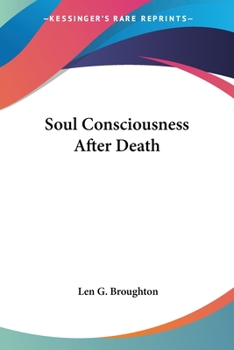
Soul Consciousness After Death
No Customer Reviews

Select Format
Select Condition 
Book Overview
""Soul Consciousness After Death"" by Len G. Broughton is a book that explores the concept of what happens to the soul after death. It delves into the idea of consciousness and how it may continue beyond physical death, providing evidence and insights from various sources such as near-death experiences, mediumship, and spiritual teachings. The author also discusses the concept of reincarnation and how it relates to soul consciousness. This book offers a thought-provoking and informative perspective on the afterlife and the nature of the soul, making it a valuable resource for those interested in spirituality and metaphysics.Titles: The Black Crepe On The Door; Where Is The Soul Beyond The Grave?; The Land On No Tears, An Eternal Hell; What Of The Fire?This scarce antiquarian book is a facsimile reprint of the old original and may contain some imperfections such as library marks and notations. Because we believe this work is culturally important, we have made it available as part of our commitment for protecting, preserving, and promoting the world's literature in affordable, high quality, modern editions, that are true to their original work.
Format:Paperback
Language:English
ISBN:1432568582
ISBN13:9781432568580
Release Date:March 2007
Publisher:Kessinger Publishing
Length:164 Pages
Weight:0.55 lbs.
Dimensions:0.4" x 6.0" x 9.0"
Customer Reviews
0 rating
Copyright © 2026 Thriftbooks.com
Terms of Use | Privacy Policy | Do Not Sell/Share My Personal Information | Cookie Policy | Cookie Preferences | Accessibility Statement
ThriftBooks ® and the ThriftBooks ® logo are registered trademarks of Thrift Books Global, LLC
ThriftBooks ® and the ThriftBooks ® logo are registered trademarks of Thrift Books Global, LLC
