


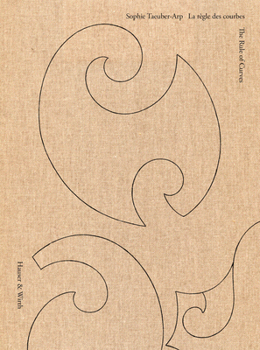
Sophie Taeuber-Arp: The Rule of Curves

Tracing the development of Taeuber-Arp's kinaesthetic formal sensibility across her short but bounteous career
Edited with an essay by art historian Briony Fer, The Rule of Curves examines the work of leading 20th-century artist and designer Sophie Taeuber-Arp. Taeuber-Arp defied categorization during her brief career through her work as a painter, sculptor, architect, performer, choreographer, teacher, writer and designer of textiles, stage sets and interiors. Reconciling extremes with confidence--Dada and Geometric Abstraction, fine art and utilitarian objects--Taeuber-Arp's works boldly engaged with the intellectual context of international modernism.
This bilingual clothbound volume is thematically driven, focusing on the formal logic that drove her innovative and wide-ranging creative production while revealing how working between mediums both expanded and crystallized her aesthetic. It particularly traces Taeuber-Arp's incorporation of curves into her geometric abstractions--a motif that elaborated upon Jean (Hans) Arp's biomorphic visual language. Alongside Fer's new critical insights into Taeuber-Arp's work, an essay by scholar Jenny Nachtigall explores the artist's "environments" and how notions of gravity, motion and the cinematic offer keys to understanding the artist's kinaesthetic sensibility.
Sophie Taeuber-Arp (1889-1943) began her applied arts practice in Zurich, where she also taught textile design and participated in the Dada movement. Starting in the late 1920s, Taeuber-Arp completed several architectural and interior design projects, most significantly the Aubette entertainment complex in Strasbourg. When she moved to Paris in 1929, she turned her attention to abstract paintings and painted wood reliefs.
Customer Reviews
ThriftBooks ® and the ThriftBooks ® logo are registered trademarks of Thrift Books Global, LLC
