Skip to content
Scan a barcode
Scan
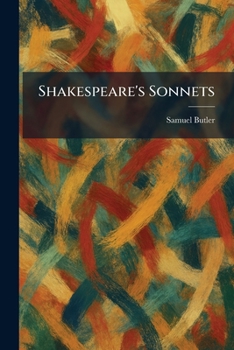
Paperback Shakespeare's Sonnets Book

ISBN: 1025503562

ISBN13: 9781025503561

Select Format

Select Condition ThriftBooks Help Icon

Recommended

Format: Paperback

Condition: New

$25.95
Ships within 2-3 days
Save to List

Book Overview

In "Shakespeares Sonnets", the Victorian author and critic Samuel Butler offers a compelling and scholarly examination of William Shakespeare's celebrated sequence of 154 poems. This work serves not only as a presentation of the iconic verses but as a deep critical inquiry into their structure, meaning, and historical context. Butler is known for his provocative theories regarding the chronology and the intended subjects of the poems, challenging traditional interpretations of the relationships between the poet, the "Fair Youth", and the "Dark Lady".

The text explores the timeless themes of love, mortality, and the power of art that define the sonnet cycle. By reordering and recontextualizing the verses, Butler provides a unique perspective that highlights the emotional intensity and lyrical complexity of Shakespeare's work. This volume is an essential resource for students of English literature and Shakespearean scholars, representing a significant moment in the history of literary analysis. It invites readers to rediscover the beauty of "Shakespeares Sonnets" through the lens of one of the 19th century's most independent and rigorous intellectual minds.

This work has been selected by scholars as being culturally important, and is part of the knowledge base of civilization as we know it. This work was reproduced from the original artifact, and remains as true to the original work as possible. Therefore, you may see the original copyright references, library stamps (as most of these works have been housed in our most important libraries around the world), and other notations in the work.

This work is in the public domain in the United States of America, and possibly other nations. Within the United States, you may freely copy and distribute this work, as no entity (individual or corporate) has a copyright on the body of the work.

As a reproduction of a historical artifact, this work may contain missing or blurred pages, poor pictures, errant marks, etc. Scholars believe, and we concur, that this work is important enough to be preserved, reproduced, and made generally available to the public. We appreciate your support of the preservation process, and thank you for being an important part of keeping this knowledge alive and relevant.

Customer Reviews

7 ratings

Timeless

Timeless and classic. Refreshingly welcomed and entertaining. This is a must collection to any library.

Disappointed.

There were no explanatory notes or paraphrasing in my copy. Disappointed.

Very pleased!

The Sonnets speak for themselves, but this particular volume is lovely and small with one numbered sonnet on each page. I love it.

Lord of my love, to whom in vassalage

Thy merit hath my duty strongly knit, To thee I send this written embassage, To witness duty, not to show my wit. (Sonnet 26.) How to do justice to the legacy of literary history's greatest mind - moreover in such a limited review? Forget Goethe's "universal genius" and his rebel contemporary Schiller; forget the 19th century masters; forget contemporary literature: with the possible (!) exception of three Greek gentlemen named Aischylos, Sophocles and Euripides, a certain Frenchman called Poquelin (a/k/a Moliere), and that infamous Irishman Oscar Wilde, there's more wit in a single line of Shakespeare's than in an entire page of most other, even great, authors' works. And I'm not saying this in ignorance of, or in order to slight any other writer: it's precisely my admiration of the world's literary giants, past and present, that makes me appreciate Shakespeare even more - and that although I'm aware that he repeatedly borrowed from pre-existing material and that even the (sole) authorship of the works published under his name isn't established beyond doubt. For ultimately, the only thing that matters to me is the brilliance of those works themselves; and quite honestly, the mysteries continuing to enshroud his person, to me, only enhance his larger-than-life stature. The precise dating of Shakespeare's sonnets - like other poets', a response to the 1591 publication of Sir Philip Sidney's "Astrophil and Stella" - is an even greater guessing game than that of his plays: although #138 and #144 (slightly modified) appeared in 1599's "Passionate Pilgrim," most were probably circulated privately, and written years before their first - unauthorized, though still authoritative - 1609 publication; possibly beginning in 1592-1593. Format-wise, they adopt the Elizabethan fourteen-line-structure of three quatrains of iambic pentameters expressing a series of increasingly intense ideas, resolved in a closing couplet; with an abab-cdcd-efef-gg rhyme form. (Sole exceptions: #99 - first quatrain amplified by one line - #126 - six couplets & only twelve lines total - #145 - written in tetrameter - and #146 - omission of the second line's beginning; the subject of a lasting debate.) Their order is thematic rather than chronological, although beyond the fact that the first 126 are addressed to a young man - maybe the Earl of Pembroke or Southampton, maybe Sir Robert Dudley, the natural son of Queen Elizabeth's "Sweet Robin," the Earl of Leicester - (the first seventeen, possibly commissioned by the addressee's family, pressing his marriage and production of an heir), and ##127-152 (or 127-133 and 147-152) to an exotic woman of questionable virtues only known as "The Dark Lady," even in that respect much remains unclear; including the nature of Shakespeare's relationship with the two main addressees, regarding which the sonnets' often ambiguous metaphors invoke much speculation. #145 is probably addressed to Shakespeare's wife; the closing couplet plays on he

Lord of my love, to whom in vassalage

Thy merit hath my duty strongly knit, To thee I send this written embassage, To witness duty, not to show my wit. (Sonnet 26.) How to do justice to the legacy of literary history's greatest mind -- moreover in such a limited review? Forget Goethe's "universal genius" and his rebel contemporary Schiller; forget the 19th century masters; forget contemporary literature: with the possible (!) exception of three Greek gentlemen named Aischylos, Sophocles and Euripides, a certain Frenchman called Poquelin (a/k/a Moliere), and that infamous Irishman Oscar Wilde, there's more wit in a single line of Shakespeare's than in an entire page of most other, even great, authors' works. And I'm not saying this in ignorance of, or in order to slight any other writer: it's precisely my admiration of the world's literary giants, past and present, that makes me appreciate Shakespeare even more -- and that although I'm aware that he repeatedly borrowed from pre-existing material and that even the (sole) authorship of the works published under his name isn't established beyond doubt. For ultimately, the only thing that matters to me is the brilliance of those works themselves; and quite honestly, the mysteries continuing to enshroud his person, to me, only enhance his larger-than-life stature. The precise dating of Shakespeare's sonnets -- like other poets', a response to the 1591 publication of Sir Philip Sidney's "Astrophil and Stella" -- is an even greater guessing game than that of his plays: although #138 and #144 (slightly modified) appeared in 1599's "Passionate Pilgrim," most were probably circulated privately, and written years before their first -- unauthorized, though still authoritative -- 1609 publication; possibly beginning in 1592-1593. Format-wise, they adopt the Elizabethan fourteen-line-structure of three quatrains of iambic pentameters expressing a series of increasingly intense ideas, resolved in a closing couplet; with an abab-cdcd-efef-gg rhyme form. (Sole exceptions: #99 -- first quatrain amplified by one line -- #126 -- six couplets & only twelve lines total -- #145 -- written in tetrameter -- and #146 -- omission of the second line's beginning; the subject of a lasting debate.) Their order is thematic rather than chronological, although beyond the fact that the first 126 are addressed to a young man -- maybe the Earl of Pembroke or Southampton, maybe Sir Robert Dudley, the natural son of Queen Elizabeth's "Sweet Robin," the Earl of Leicester -- (the first seventeen, possibly commissioned by the addressee's family, pressing his marriage and production of an heir), and ##127-152 (or 127-133 and 147-152) to an exotic woman of questionable virtues only known as "The Dark Lady," even in that respect much remains unclear; including the nature of Shakespeare's relationship with the two main addressees, regarding which the sonnets' often ambiguous metaphors invoke much speculation. #145 is probably addressed to Shakespeare's wife; the closing coup

romeo and juliet

romeo and juliet is about a family that hated each other by last names.but a daughter of the family fell in love with a Montague because of his kindness towards her. the book is sad in mind , body and soul to understan how to love a person

Full of life

I read these sonnets two a day over the summer, and I wish there were more than 154 of them so I could keep going into the fall. I think I'll pick up "The Tempest" next.The poetry in this volume is beautiful, equisite and full of passion. What makes Shakespeare worth reading is the way he lets the world into his lines. His metaphors appeal deliciously to the senses, like a beam of sunlight through a high window in the afternoon, or the smell of a new cut lawn in the spring. Shakespeare's writing is immortal, not because a conspiracy of teachers got together and decided it should be, but because it is full of life, and nothing that is full of life can really ever die.If you're not used to reading Elizabthean English or are put off by the thought of Shakespeare, this is a good place to start. This edition helpfully "translates" each sonnet into modern English on a facing page along with definitions for the more troubling words. Even with the help, I still don't think Shakespeare is all that easy to read. But anything you do in this world that makes you feel more passionate about life is a pretty good thing. If you give Shakespeare some of your time, he's bound to pay you back with plenty of interest.
Copyright © 2026 Thriftbooks.com Terms of Use | Privacy Policy | Do Not Sell/Share My Personal Information | Cookie Notice | Cookie Preferences | Accessibility Statement
ThriftBooks ® and the ThriftBooks ® logo are registered trademarks of Thrift Books Global, LLC

GoDaddy Verified and Secured