


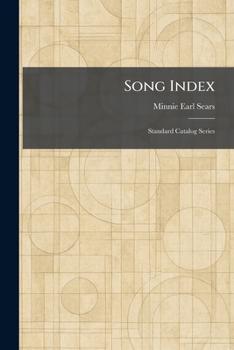
Song Index: Standard Catalog Series

"Song Index" is a monumental reference work designed to simplify the search for vocal music across various collections. Compiled by the renowned bibliographer Minnie Earl Sears, this exhaustive index provides a systematic approach to identifying and locating thousands of songs. It serves as an essential tool for librarians, researchers, and vocalists seeking specific titles, composers, or authors within the vast landscape of published song collections.
The work covers a wide array of musical styles and genres, offering a bridge between the sheet music of the era and the scholarly need for organized data. By meticulously cataloging individual entries, "Song Index" ensures that rare and popular compositions alike are discoverable. This volume reflects the meticulous standards of bibliographic classification, showcasing a dedication to precision and utility that has made it a cornerstone of music bibliography.
Whether used for historical research or practical performance planning, this index remains a testament to the importance of organized musical knowledge. Its structured format allows users to navigate through a massive corpus of material with ease, making it an invaluable asset for any serious study of vocal repertoire and musical history.
This work has been selected by scholars as being culturally important, and is part of the knowledge base of civilization as we know it. This work was reproduced from the original artifact, and remains as true to the original work as possible. Therefore, you may see the original copyright references, library stamps (as most of these works have been housed in our most important libraries around the world), and other notations in the work.
This work is in the public domain in the United States of America, and possibly other nations. Within the United States, you may freely copy and distribute this work, as no entity (individual or corporate) has a copyright on the body of the work.
As a reproduction of a historical artifact, this work may contain missing or blurred pages, poor pictures, errant marks, etc. Scholars believe, and we concur, that this work is important enough to be preserved, reproduced, and made generally available to the public. We appreciate your support of the preservation process, and thank you for being an important part of keeping this knowledge alive and relevant.
Customer Reviews
ThriftBooks ® and the ThriftBooks ® logo are registered trademarks of Thrift Books Global, LLC
