


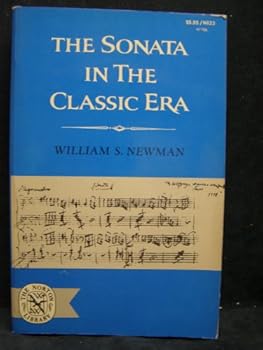
The sonata in the classic era, (His A history of the sonata idea)


Select Format
Select Condition 
Book Overview
A major scholarly structure of which not only [William S. Newman] but all of American musicology can be proud of. . . . It will be permanently indispensable to teachers, performers, libraries, and... This description may be from another edition of this product.
Format:Hardcover
Language:English
ISBN:0393006239
ISBN13:9780393006230
Release Date:January 1972
Publisher:W. W. Norton & Company, Incorporated
Length:917 Pages
Weight:1.79 lbs.
Dimensions:8.0" x 1.0" x 5.0"
Customer Reviews
2 ratings
Use this more as a reference book. This is the central volume of the three.
Published by Thriftbooks.com User , 20 years ago
This is the central volume in William S. Newman's monomaniacal project on the history of the sonata idea. The book surveys composers and the kinds of works they wrote that they call sonata. It is the survey aspect rather than the analytical aspect that needs to be remembered. More than one person has wondered at the sheer volume of information contained here and why anyone would want to know all of this. Others have wondered what it means to call a work a sonata when it has been applied to so many varied kinds of works. It is in the classic era (i.e. Haydn, Mozart, Beethoven, et al) that the "sonata" becomes the most codified. There is the actual "sontata-form" and the decades of debate surrounding all that this binary-three part form really means. However, there is also the instrumental sonata as a multi-movement work and the various components composers have used over the centuries there. However, it can also mean a single movement work. So, it is interesting to survey all of this difference under a single heading. I remember a class where we wondered at all these names no one knew and we went to the library and dug up some of their works, brought them to class and played them. After hearing them we decided that history was right to note the difference between Haydn, Mozart, and Beethoven and few others while forgetting so many of the rest. There is a difference. Newman notes that thousands of sonatas were written in these decades just as thousands of novels are written in our time. Just as most of the novels are not only not worth reading, they are a waste of everyone's resources, so are most of the sonatas. However, the gems are truly delightful and make all the waste worthwhile. Nature is prodigal in the creation of fish eggs, so she might as well be the same with musicians and their music as well. I see this more as a reference book and something you dip in and out of rather than something to plow through front to back. You can't possibly remember it all or even figure out why you would want to.
This author has a lot to say, and so do I.
Published by Thriftbooks.com User , 20 years ago
When I bought this 800-page volume, I expected an analysis of the sonata form. Instead, I got a historical treatise on the subject. As a historical treatise, however, one could not ask for more. The bibliography alone is 59 pages long. Moreover, the author apparently read through hundreds of sonatas in preparation for this book. It staggers the imagination that the author's lifetime allowed enough time to write not only this book, but two more comparable works on the sonata before and after the classical era. There is a discussion on Domenico Alberti, whom most of us know only as the name for the "Alberti bass." That got me so curious that I ordered a photocopy of his music from the Library of Congress. There is also a discussion on Muzio Clementi, whom we know chiefly for his 6 Sonatinas. There were numerous discussions on composers who have been long forgotten. Through these long hours of reading, one could learn many interesting facts. Here is a sampling: --Two of Clementi's sonatas, which contain the Morse code V rhythm, might have inspired Beethoven's Fifth Symphony. --The nickname for Beethoven's "Tempest" Sonata comes from a biographer who claims that mentioned literary as inspiration for some of his piano sonatas. If that biographer had unbridled rein, the "Moonlight" Sonata would be the "King Lear" Sonata, the "Pastorale" Sonata would be "A Winter's Tale" Sonata, and the "Waldstein" Sonata would be the "Odyssey" Sonata. --The "Moonlight" Sonata reminded Berlioz of sunshine rather than moonlight. --Sonatas with prominent keyboard parts and subordinate violin parts were customary at the time. It seems that most of those violin parts are easy enough for first-year students. If I had known about those sonatas when I was a beginner on the violin, I would have found those sonatas preferable to the usual fare. I suggest this book for violin teachers. --Many keyboard sonatas are short and easy. Surely many students would find these sonatas preferable to supercilious piano instruction books with song lyrics, programmatic titles, and illustrations. I suggest this book for piano teachers. --There have been a few sonatas composed which depict drum rolls, bugle calls, military marches, and gunfire heard during a battle. "The Battle of Prague" by Franz Koczwara and "The Fourth of July" by James Hewitt are outstanding examples. I suggest this book for music appreciation teachers. Just two complaints: --He uses unfamiliar words which he does not define. One can only guess from the context that the "empfindsan" style is more profound than the "galant" style. He refers frequently to "the Mannheim school," which had a distinct style which he would not describe. I cannot eveb find "epigonic" in the dictionary. --The author sometimes appears snobbish. On page 131, he says, "Every serious reader will have his complete Beethoven sonatas at hand." Any violin student who does not practice the Kreutzer etudes (540) and the R
Copyright © 2026 Thriftbooks.com Terms of Use
| Privacy Policy | Do Not
Sell/Share My Personal Information | Cookie Policy | Cookie Preferences | Accessibility Statement
ThriftBooks® and the ThriftBooks® logo are registered trademarks of Thrift Books Global, LLC
ThriftBooks® and the ThriftBooks® logo are registered trademarks of Thrift Books Global, LLC
