


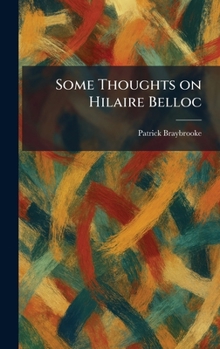
Some Thoughts on Hilaire Belloc

"Some Thoughts on Hilaire Belloc" is an insightful contemporary examination of one of the most versatile and influential figures in early 20th-century English letters. Written by Patrick Braybrooke, this work provides a focused analysis of Belloc's multifaceted career as a poet, historian, essayist, and political thinker. Braybrooke offers a thoughtful appraisal of Belloc's unique prose style, his intellectual vigor, and the deep-seated convictions that shaped his prolific output.
The study delves into the core themes of Belloc's work, exploring his mastery of the English language and his role as a prominent Catholic apologist and social critic. By evaluating Belloc's impact on his contemporaries and the literary landscape of the 1920s, Braybrooke captures the essence of a man known for both his wit and his unwavering defense of tradition. From his travel writing to his satirical verse, the book surveys the breadth of Belloc's contributions to literature.
This volume serves as both a critical introduction for new readers and a valuable historical document for scholars of the Edwardian and Georgian eras. "Some Thoughts on Hilaire Belloc" remains a vital resource for understanding the legacy of a writer who challenged the status quo and left an indelible mark on British intellectual life.
This work has been selected by scholars as being culturally important, and is part of the knowledge base of civilization as we know it. This work was reproduced from the original artifact, and remains as true to the original work as possible. Therefore, you may see the original copyright references, library stamps (as most of these works have been housed in our most important libraries around the world), and other notations in the work.
This work is in the public domain in the United States of America, and possibly other nations. Within the United States, you may freely copy and distribute this work, as no entity (individual or corporate) has a copyright on the body of the work.
As a reproduction of a historical artifact, this work may contain missing or blurred pages, poor pictures, errant marks, etc. Scholars believe, and we concur, that this work is important enough to be preserved, reproduced, and made generally available to the public. We appreciate your support of the preservation process, and thank you for being an important part of keeping this knowledge alive and relevant.
Customer Reviews
ThriftBooks ® and the ThriftBooks ® logo are registered trademarks of Thrift Books Global, LLC
