


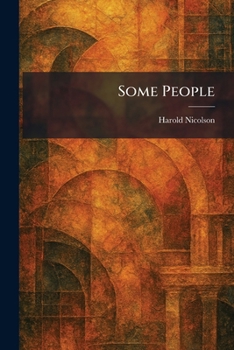
Some People

"Some People" is a brilliant collection of semi-autobiographical sketches that blurs the line between fiction and memoir. Written by the esteemed diplomat and author Harold Nicolson, this work offers a series of nine character portraits based on individuals the author encountered throughout his childhood and his distinguished career in the British Foreign Office.
Through figures such as the precocious Jeanne de H nault, the bumbling Titty, and the formidable Lord Curzon, Nicolson provides a witty and perceptive examination of the British social and political landscape during the early 20th century. The book is celebrated for its sophisticated prose, keen psychological insight, and understated satire. By blending personal recollection with literary artifice, Nicolson explores themes of social class, the rigors of the diplomatic service, and the eccentricities of the English elite.
"Some People" remains a significant piece of interwar literature, reflecting the transition from Victorian sensibilities to the modern era. Its enduring charm lies in its ability to capture the essence of a bygone world with both affection and sharp-edged irony, making it an essential read for those interested in the history of British diplomacy and the art of the literary portrait.
This work has been selected by scholars as being culturally important, and is part of the knowledge base of civilization as we know it. This work was reproduced from the original artifact, and remains as true to the original work as possible. Therefore, you may see the original copyright references, library stamps (as most of these works have been housed in our most important libraries around the world), and other notations in the work.
This work is in the public domain in the United States of America, and possibly other nations. Within the United States, you may freely copy and distribute this work, as no entity (individual or corporate) has a copyright on the body of the work.
As a reproduction of a historical artifact, this work may contain missing or blurred pages, poor pictures, errant marks, etc. Scholars believe, and we concur, that this work is important enough to be preserved, reproduced, and made generally available to the public. We appreciate your support of the preservation process, and thank you for being an important part of keeping this knowledge alive and relevant.
Customer Reviews
ThriftBooks ® and the ThriftBooks ® logo are registered trademarks of Thrift Books Global, LLC
