


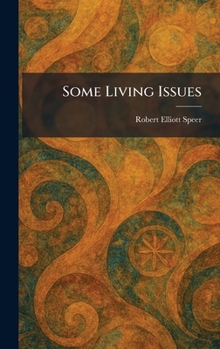
Some Living Issues

"Some Living Issues" is a profound exploration of the theological and social challenges facing the Christian faith in the early twentieth century. Written by the influential missionary leader and layman Robert E. Speer, this work addresses the pressing questions of his era-matters of belief, the purpose of the church, and the application of Christian principles to a rapidly changing world. Speer brings his decades of experience in global missions and ecclesiastical leadership to bear on topics such as the personality of Jesus Christ, the authority of Scripture, and the necessity of personal devotion.
The book serves as a clarion call for a robust, active faith that does not shy away from the intellectual and practical difficulties of modern life. Through a series of thoughtful essays, Speer examines the core tenets of Christianity and their relevance to both the individual soul and society at large. His prose is marked by the conviction and clarity that made him one of the most respected voices in American religious life. "Some Living Issues" remains a significant historical document for those interested in the development of Protestant thought, the history of ecumenical movements, and the enduring quest for a meaningful spiritual life amidst the complexities of the modern age.
This work has been selected by scholars as being culturally important, and is part of the knowledge base of civilization as we know it. This work was reproduced from the original artifact, and remains as true to the original work as possible. Therefore, you may see the original copyright references, library stamps (as most of these works have been housed in our most important libraries around the world), and other notations in the work.
This work is in the public domain in the United States of America, and possibly other nations. Within the United States, you may freely copy and distribute this work, as no entity (individual or corporate) has a copyright on the body of the work.
As a reproduction of a historical artifact, this work may contain missing or blurred pages, poor pictures, errant marks, etc. Scholars believe, and we concur, that this work is important enough to be preserved, reproduced, and made generally available to the public. We appreciate your support of the preservation process, and thank you for being an important part of keeping this knowledge alive and relevant.
Customer Reviews
ThriftBooks ® and the ThriftBooks ® logo are registered trademarks of Thrift Books Global, LLC
