


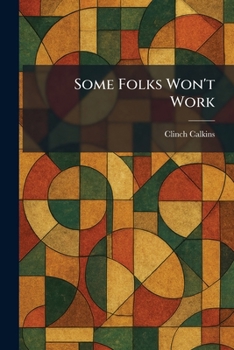
Some Folks Won't Work

"Some Folks Won't Work" is a seminal sociological examination of unemployment in industrial America during the late 1920s and the onset of the Great Depression. Written by Clinch Calkins, the work provides a poignant and data-driven rebuttal to the prevailing social stigma that joblessness was merely a result of personal failure or laziness. Through a series of compelling case studies and statistical observations, Calkins illustrates the systemic economic forces that leave able-bodied workers without means of support.
The book explores the devastating impact of cyclical economic downturns on family life, health, and social stability, highlighting the human cost of industrial instability. By documenting the lived experiences of those struggling to find labor in a shifting economy, "Some Folks Won't Work" serves as a critical historical document that influenced early 20th-century social policy and labor reform. It remains a powerful testament to the necessity of social safety nets and provides a profound understanding of the complexities of the labor market and the social structures that govern it.
This work has been selected by scholars as being culturally important, and is part of the knowledge base of civilization as we know it. This work was reproduced from the original artifact, and remains as true to the original work as possible. Therefore, you may see the original copyright references, library stamps (as most of these works have been housed in our most important libraries around the world), and other notations in the work.
This work is in the public domain in the United States of America, and possibly other nations. Within the United States, you may freely copy and distribute this work, as no entity (individual or corporate) has a copyright on the body of the work.
As a reproduction of a historical artifact, this work may contain missing or blurred pages, poor pictures, errant marks, etc. Scholars believe, and we concur, that this work is important enough to be preserved, reproduced, and made generally available to the public. We appreciate your support of the preservation process, and thank you for being an important part of keeping this knowledge alive and relevant.
Customer Reviews
ThriftBooks ® and the ThriftBooks ® logo are registered trademarks of Thrift Books Global, LLC
