


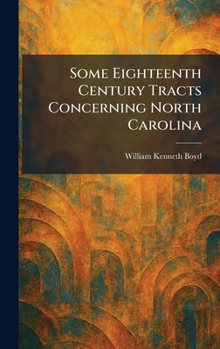
Some Eighteenth Century Tracts Concerning North Carolina

"Some Eighteenth Century Tracts Concerning North Carolina" is a comprehensive compilation of primary source documents that offer a detailed window into the development and governance of the North Carolina colony throughout the 1700s. Curated by historian William Kenneth Boyd, this collection gathers together rare pamphlets, letters, and reports that provide firsthand perspectives on the social, economic, and political life of the era.
The tracts included in this volume address a wide array of historical subjects, from the hardships of early settlement and the establishment of religious institutions to the complex administrative challenges faced by colonial authorities. These documents are vital for understanding the internal dynamics of North Carolina as it transitioned through the century, reflecting the concerns of both the governing class and the pioneer population. By preserving these elusive writings, the work serves as an indispensable resource for scholars of early American history, genealogists, and those interested in the foundational years of the American South. This collection emphasizes the unique regional identity of North Carolina and its contribution to the broader narrative of the original thirteen colonies.
This work has been selected by scholars as being culturally important, and is part of the knowledge base of civilization as we know it. This work was reproduced from the original artifact, and remains as true to the original work as possible. Therefore, you may see the original copyright references, library stamps (as most of these works have been housed in our most important libraries around the world), and other notations in the work.
This work is in the public domain in the United States of America, and possibly other nations. Within the United States, you may freely copy and distribute this work, as no entity (individual or corporate) has a copyright on the body of the work.
As a reproduction of a historical artifact, this work may contain missing or blurred pages, poor pictures, errant marks, etc. Scholars believe, and we concur, that this work is important enough to be preserved, reproduced, and made generally available to the public. We appreciate your support of the preservation process, and thank you for being an important part of keeping this knowledge alive and relevant.
Related Subjects
HistoryCustomer Reviews
ThriftBooks ® and the ThriftBooks ® logo are registered trademarks of Thrift Books Global, LLC
