


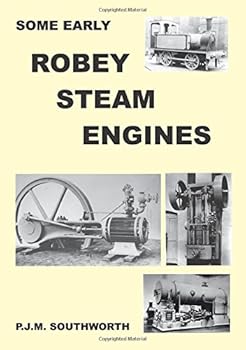
Some Early Robey Steam Engines
No Customer Reviews

Robert Robey was born in Nottingham in 1826. He established the business in Lincoln in 1854 with George Lamb Scott as Robey & Scott, at the Perseverance Ironworks. In 1854 Robey & Scott built the first iron framed threshing machine. Another partner Thomas Gamble joined the firm, Scott resigned in September 1856 and became Gamble & Robey. Robey Steam wagon The Robey Steam WagonIn 1861 the firm produced its first portable steam engine, moving on to traction engines. They also made steam engines for industry, railways and steam wagons for the road. Robeys was an important employer in Lincoln, employing 114 men by 1865. By 1868 the firm was known as Robey & Co Ltd. The Perseverance Ironworks was enlarged in 1871 and covered a total area along Canwick Road of seven acres.Robert Robey died in 1876, at the age of 50, in Nottingham where he then lived, taking a less active part in the running of the business.Robeys are believed to have built a prototype of steam ploughing equipment to the designs of W. Savory, but did not pursue this further. A Robey steam engine won a gold medal for reliability at the Paris Exhibition in 1878.By 1885 Robeys manufacturing took place at the Globe Ironworks, reflecting their world- wide sales, which was possibly a renaming of the site rather than a move to new premisesRobeys produced threshing machines, saw benches, mills, and elevators, all for steam power. Electrical plant supplied by Robeys lit Lincoln Cathedral to celebrate both the Golden and Diamond Jubilees of Queen Victoria. The electric winding gear for Blackpool Tower was produced by Robeys. Robeys main customers for winding gear were coal mines.The strength of their general steam engineering business in boilers, stationary engines, etc. enabled the firm to survive the decline of agricultural steam business after the First World War. The firm added road rollers to the product range in the 1920s, and after 1945 moved into electrical and diesel engineering, finally going out of business in February 1988.This book was first printed in 1986
Format:Paperback
Language:English
ISBN:1500149713
ISBN13:9781500149710
Release Date:June 2014
Publisher:CreateSpace Independent Publishing Platform
Length:44 Pages
Weight:0.79 lbs.
Dimensions:11.7" x 0.1" x 8.3"
Customer Reviews
0 rating
Copyright © 2025 Thriftbooks.com
Terms of Use | Privacy Policy | Do Not Sell/Share My Personal Information | Cookie Policy | Cookie Preferences | Accessibility Statement
ThriftBooks ® and the ThriftBooks ® logo are registered trademarks of Thrift Books Global, LLC
ThriftBooks ® and the ThriftBooks ® logo are registered trademarks of Thrift Books Global, LLC
