


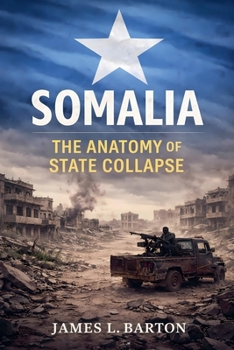
Somalia: The Anatomy of State Collapse

Somalia is often described as a failed state. But failure suggests something that once worked and then broke. In Somalia's case, the problem runs deeper.
Since the collapse of the Siad Barre regime in 1991, repeated international efforts have attempted to rebuild a central government, restore national institutions, and impose stability. None have succeeded. Peace agreements have produced governments without authority. Foreign intervention has delivered only temporary order. More than three decades on, Somalia remains locked in prolonged political collapse.
This book argues that Somalia's condition is not the result of chaos, corruption, or cultural deficiency, but of a structural mismatch between the modern nation-state model and the social and economic realities of Somali society. Long before colonial partition, Somalis governed themselves through clan-based systems adapted to pastoral life, mobility, and scarce resources. Colonial borders, Cold War militarisation, and post-independence state-building imposed institutions that never aligned with how authority, loyalty, and security actually functioned on the ground.
Tracing Somalia's trajectory from pre-colonial social order through colonial rule, military dictatorship, civil war, Islamism, and sustained foreign intervention, this book explains why repeated attempts at reconstruction have failed, and why relative stability emerged only where centralised statehood was abandoned.
A concise, historically grounded analysis of Somalia's political collapse and what it reveals about the limits of modern state-building.
Customer Reviews
ThriftBooks® and the ThriftBooks® logo are registered trademarks of Thrift Books Global, LLC
