


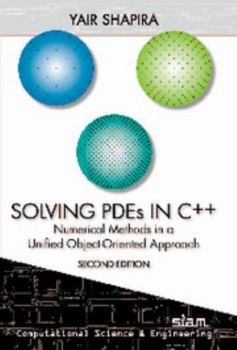
Solving Pdes in C++: Numerical Methods in a Unified Object-Oriented Approach


This text provides a comprehensive guide for the numerical solution of PDEs using C++ within an object-oriented approach. The high level of abstraction available in C++ is particularly useful in the... This description may be from another edition of this product.
Format:Paperback
Language:English
ISBN:1611972167
ISBN13:9781611972160
Release Date:August 2012
Publisher:Society for Industrial and Applied Mathematic
Length:800 Pages
Customer Reviews
2 ratings
Good but could be Better
Published by Thriftbooks.com User , 19 years ago
I've had the book for several weeks now and have worked through most of the book and tried to use several of the example classes. From the perspective of an engineer who writes a lot of code for engineers to use and understand I'd say the book is definitely written from a computer scientists point of view with heavy use of templates, inheritance and operator overloading. Several of the code examples are missing parts such as a default constructor in the template for the point class needed to run the ultra simple example. Also, there are several inaccuracies such as claiming in Fortran you must declare array sizes at compile time. This hasn't been the case in over 14 years. I still give the book 4 stars for being the only book of its kind plus it isn't all bad. There are some good ideas presented especially in the use of templates and how to use objects to build up a hierarchy from points to meshes. This was presented in a well detailed way which was easy to understand and really improved my understanding of templates, classes and OOP.
Excellent for C/C++ Programmers who need this type of Math, but ...
Published by Thriftbooks.com User , 19 years ago
The book does give a good introduction to C/C++ if that is what you need. If you already are an expert at C/C++, this book is excellent introduction for applying PDE's with C/C++, though I could have asked for more examples. I bought the book to help me write better PDE's in my work with Image Processing, Fuzzy Logic, Neural Networks. The Author does explain thing in a very concise way, but be prepared to do research and work through the exercises. However, there is some noticable code in the book that just does not work, but can be easily corrected. There is also some misinformation with the STL library and it's capabities. This can be a problem for those not well versed in the STL. Also some of the functionality is not as effiecent or well written as he claims to be. This is especially true the operator overloads, but it not bad. Otherwise I would have given it a five star.
Copyright © 2026 Thriftbooks.com Terms of Use
| Privacy Policy | Do Not
Sell/Share My Personal Information | Cookie Policy | Cookie Preferences | Accessibility Statement
ThriftBooks® and the ThriftBooks® logo are registered trademarks of Thrift Books Global, LLC
ThriftBooks® and the ThriftBooks® logo are registered trademarks of Thrift Books Global, LLC
