


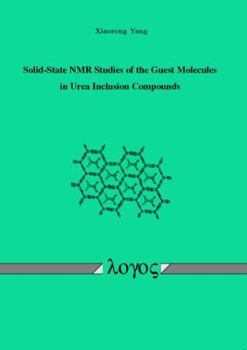
Solid-State NMR Studies of the Guest Molecules in Urea Inclusion Compounds
No Customer Reviews

This thesis work deals with the investigation of the structural and dynamic
properties of various guest species in urea inclusion compounds. Urea inclusion
compounds are widely used in chemical analyses and syntheses. Studies of the
molecular properties of the guest and host components are therefore of intrinsic
scientific interest. Solid-state NMR spectroscopy is particularly suitable for the
evaluation of the guest dynamics as well as the structural properties in such
materials.
The molecular behavior (dynamics, molecular order) of ?, ?-dibromoalkanes/urea
inclusion compounds (CnH2nBr2, n = 6, 10, 11) with different selectively deuterated
guest components was studied via solid-state 2H NMR spectroscopy, comprising
variable-temperature line shape studies, spin-lattice and spin-spin relaxation
experiments. In addition, the conformational properties were probed by high
resolution solid-state 13C and 1H NMR experiments. For the long-chain guest systems
(n = 10, 11), the guest dynamics at best can be described by the presence of overall
reorientations around the channel axis (modeled by a non-degenerate jump motion)
along with chain fluctuations. For the dibromohexane/urea inclusion compound, the
guest species exclusively exist in distinct gauche conformations, which undergo
exchange with rate constants that match the NMR time-scale. For comparison, the
molecular properties of 1-bromodecane in urea have been studied as well. Both the
molecular order and dynamics can be described in quite the same way as found for 1,
10-dibromodecane or 1, 11-dibromo- undecane in urea.
Furthermore, this work reports on 1H and 13C CP/MAS NMR studies on urea inclusion
compounds with various types of guest species (n-alkanes, alkane derivatives of
different chain lengths). These studies include high-speed MAS experiments as well
as T1? and T1 relaxation experiments. High resolution 1H and 13C spectra manifest
that the guests in urea channels are of high mobility. From the T1? data, the motion
of the guest on the microsecond time scale might be explained by chain fluctuations
and lateral motion and the interaction between the guest and host is confirmed.
Format:Paperback
Language:English
ISBN:383251533X
ISBN13:9783832515331
Release Date:March 2007
Publisher:Logos Verlag Berlin
Length:197 Pages
Weight:0.30 lbs.
Dimensions:0.5" x 5.7" x 8.1"
Customer Reviews
0 rating
Copyright © 2026 Thriftbooks.com
Terms of Use | Privacy Policy | Do Not Sell/Share My Personal Information | Cookie Notice | Cookie Preferences | Accessibility Statement
ThriftBooks ® and the ThriftBooks ® logo are registered trademarks of Thrift Books Global, LLC
ThriftBooks ® and the ThriftBooks ® logo are registered trademarks of Thrift Books Global, LLC
