


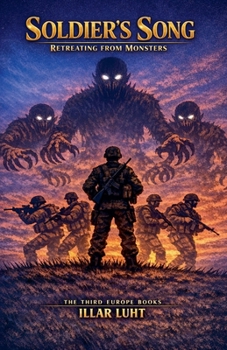
Soldier's Song Retreating from Monsters

There are places in Europe where history does not unfold - it accumulates.
It gathers in corners, settles into the grain of wood, lingers in the pauses between sentences.
Joker Homeros Salmon moves through such places the way one moves through a house inherited from distant relatives: with curiosity, with caution, with the faint sense that the walls remember more than they reveal.
When one steps back from all these rooms - Tartu, Zhdanov, the family kitchen, the construction site, the tram-lined streets of Budapest - a pattern emerges.
Not a pattern of cause and effect, but of atmosphere.
Joker's life is not a sequence of events but a sequence of climates.
He is shaped not by what he chooses, but by what he breathes.
And yet he remains in motion.
He is not a figure frozen in amber.
He is a man moving through a continent that is itself shifting - a continent where the past has not settled, where the present is provisional, where the future is a negotiation between memory and possibility.
The story that follows does not return to the Baltic or the barracks.
Those rooms have done their work.
The next rooms belong to Hungary, to the Carpathian Basin, to the uneasy, shimmering terrain of Eastern Europe.
Here the air is different.
Here the past reenacts itself in new costumes.
Here nostalgia and disillusionment walk side by side.
Joker will encounter new climates: the bureaucratic labyrinths of post-transition institutions, the ideological crosswinds of Budapest caf s, the slow, stubborn rhythms of provincial towns, the quiet tremors of nations remembering and forgetting at the same time.
He will drift into stories that do not belong to him, yet somehow claim him.
He will sense the shifts in the air before others notice them.
The rooms ahead will test him in ways the earlier ones only prepared him for.
They will demand not obedience, nor confession, but recognition.
And so the story continues.
Not with an ending, but with a door opening onto another room.
Customer Reviews
ThriftBooks ® and the ThriftBooks ® logo are registered trademarks of Thrift Books Global, LLC
