


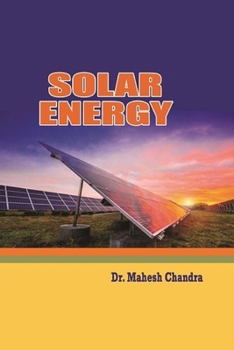
Solar Energy
No Customer Reviews

The excitation of a molecules required to initiate chemical reactions can be accomplished by the methods of photochemistry or electrochemistry. The techniques are usually more selective than thermal processes, and they often allow activation of one type of compound in the presence of another. For photo activation to take place, a portion of the molecule must be capable of absorbing radiant energy, usually from ultraviolet light. Activation of such a chromophore is the result of excitation of bonding or nonbonding electron into an antibonding molecular orbital. The rules of quantum mechanism predict which electronic transitions are favorable. Various radiative and nonradiative relaxation processes enable excited molecules to return to ground -state configurations. When these processes involve bond making or breaking, photochemistry occurs.
Format:Paperback
Language:English
ISBN:1794731725
ISBN13:9781794731721
Release Date:November 2019
Publisher:Lulu.com
Length:82 Pages
Weight:0.27 lbs.
Dimensions:0.2" x 6.0" x 9.0"
Customer Reviews
0 rating
Copyright © 2026 Thriftbooks.com
Terms of Use | Privacy Policy | Do Not Sell/Share My Personal Information | Cookie Notice | Cookie Preferences | Accessibility Statement
ThriftBooks ® and the ThriftBooks ® logo are registered trademarks of Thrift Books Global, LLC
ThriftBooks ® and the ThriftBooks ® logo are registered trademarks of Thrift Books Global, LLC
