


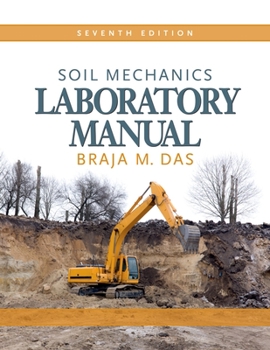
Soil Mechanics Laboratory Manual


Select Format
Select Condition 
Book Overview
Soil Mechanics Laboratory Manual is the market-leading manual for junior-level soil mechanics/geotechnical engineering laboratory courses. It teaches students the essential properties of soils and their behavior under stress and strain and provides clear, step-by-step explanations for conducting typical soil tests. The careful explanations of laboratory procedures help foster students' independence, reduce errors, and improve safety. Written by Braja M. Das, respected author of acclaimed texts in geotechnical and foundation engineering, this manual also provides a detailed discussion of the AASHTO Classification System and the Unified Soil Classification System. This seventh edition is enhanced by five appendices, including the newly added Appendix E that contains semi-log and linear duplicate graph paper. Features Comprehensive selection of class-tested labs
New photograph program to better illustrate textual material
Includes sample calculations and graphs relevant to each laboratory test
Includes blank, perforated data sheets (accompanying each test) for ease-of-use in the laboratory and teaching simple, best-practice report preparation
Provides references and five useful appendices:
Appendix A: Weight-Volume Relationships
Appendix B: Conversion Factors
Appendix C: Data Sheets for Laboratory Experiments
Appendix D: Data Sheets for Preparation of Laboratory Reports
Appendix E: Semi-log and Linear Duplicate Graph Paper
New photograph program to better illustrate textual material
Includes sample calculations and graphs relevant to each laboratory test
Includes blank, perforated data sheets (accompanying each test) for ease-of-use in the laboratory and teaching simple, best-practice report preparation
Provides references and five useful appendices:
Appendix A: Weight-Volume Relationships
Appendix B: Conversion Factors
Appendix C: Data Sheets for Laboratory Experiments
Appendix D: Data Sheets for Preparation of Laboratory Reports
Appendix E: Semi-log and Linear Duplicate Graph Paper
Format:Paperback
Language:English
ISBN:0195367596
ISBN13:9780195367591
Release Date:October 2008
Publisher:Oxford University Press, Incorporated
Length:432 Pages
Weight:2.28 lbs.
Dimensions:8.4" x 1.1" x 10.7"
Customer Reviews
2 ratings
Good book, but still has errors
Published by Thriftbooks.com User , 17 years ago
I have used this book for many years in my Soils & Foundations class that I teach at the University of New Hampshire, and just upgraded to this latest 7th Edition. I was very glad to find that they finally dropped the included diskette that used to be glued into the back, the files on it were very old and frankly worthless, and the "install" routine never worked correctly. I'm pleased my students are no longer paying for it. In general, this is a good book that works well with classes that are in a 2-year AAS program, and it would probably suffice in a 4-year Civil Engineering soils mechanics class. The photos and diagrams are good and clear, as are the descriptions. The blank data sheets in the Appendices are a great addition, as long as you don't care about re-selling the book later. The new graph paper sheets in the back in this edition are also nice, but I still provide my own to my students so they can save their books. The perforations are not very well done, it can be tough to tear out the sheets if you want. I think it would be much better to provide the data sheets and graph paper as PDFs that the students could download from a web page on the Oxford Press website, this would also save a lot of paper and cost of producing the book (hello publishers!! college textbooks are too expensive!!). I also wish this book was spiral-bound so it would properly lay flat when reading the exercises of filling in the datasheets. Probably the biggest detractor in this book is the errors in a few places, that have been there for many editions. I tried to email the author my comments after the previous edition came out, but apparently he never got it, as the errors are still there in this edition. I'll try again, but meanwhile I just point them out to my students so they don't get caught by them.
to a geotechnical engineerit is a BIBLE
Published by Thriftbooks.com User , 25 years ago
I have gone through all the experiments carefully,I have found the sequences,the calculations and the method or representing the results in an examplary manner,The simplicity with which the matter has been explained is worth praising.
Copyright © 2026 Thriftbooks.com
Terms of Use | Privacy Policy | Do Not Sell/Share My Personal Information | Cookie Policy | Cookie Preferences | Accessibility Statement
ThriftBooks ® and the ThriftBooks ® logo are registered trademarks of Thrift Books Global, LLC
ThriftBooks ® and the ThriftBooks ® logo are registered trademarks of Thrift Books Global, LLC
