


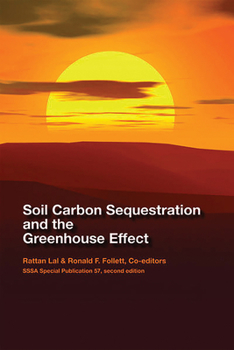
Soil Carbon Sequestration and the Greenhouse Effect
No Customer Reviews

It's hard to believe that the Greenhouse Effect is a concept that is now more than a century old, but today the observed and predicted climate changes attributed to the anthropogenic increases in atmospheric CO2 more urgently repeat the question, what can be done? The strategy of soil carbon sequestration is gaining importance because of the growing need to offset the rapidly increasing atmospheric concentration of CO2. The term soil carbon sequestration implies that the total C pool in the soil profile can be increased through managerial interventions aimed at transferring atmospheric CO2 to the soil C pool by moderating organic and/or inorganic transformations, either through humification of photosynthetic biomass or formation of secondary carbonates. The transfer of soil C to the atmospheric pool has created a C deficit in world soils, the so-called "C sink." This C sink capacity can be filled by conversion to a restorative land use (e.g., reforestation, perennial vegetation cover) and adoption of recommended management practices that create positive C and nutrient budgets, as well as favorable soil temperate and moisture regimes. Over and above its potential to offset anthropogenic emissions, soil C sequestration has numerous benefits related to ecosystem services. Important among these are food security, water quality, and biodiversity. This volume is the second edition of SSSA Special Publication 57, first published in 2001. The present edition is an update of the concepts, processes, properties, practices and the supporting data. All chapters are new contributions by both authors of the first edition and new invited authors. The expanded second edition includes 23 chapters, with a substantial new introduction and concluding chapter. New themes addressed are urban soils, minesoils, biochemically recalcitrant compounds, carbonaceous materials, belowground C storage by woody plants, and peat soils. The geographic focus of the book is North America. While a majority of contributions are from the United States, there are important chapters from Canada and Mexico. Thematically, the second edition encompasses data from modeling, lab analyses, plot studies, landscape assessment, and regional evaluation of soil C pools and fluxes. The second edition of Soil Carbon Sequestration and the Greenhouse Effect is essential reading for those interested in advancing our efforts to address global warming by understanding the processes, properties, and practices affecting the soil C pool and its dynamics.
Format:Misc.
Language:English
ISBN:0891188592
ISBN13:9780891188599
Release Date:January 1
Publisher:Acsess
Customer Reviews
0 rating
Copyright © 2026 Thriftbooks.com
Terms of Use | Privacy Policy | Do Not Sell/Share My Personal Information | Cookie Policy | Cookie Preferences | Accessibility Statement
ThriftBooks ® and the ThriftBooks ® logo are registered trademarks of Thrift Books Global, LLC
ThriftBooks ® and the ThriftBooks ® logo are registered trademarks of Thrift Books Global, LLC
