


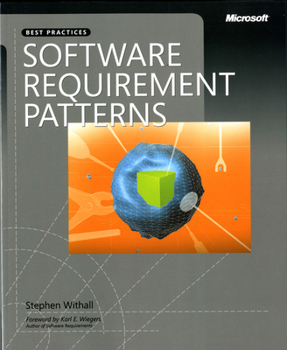
Software Requirement Patterns (Developer Best Practices)

Learn proven, real-world techniques for specifying software requirements with this practical reference. It details 30 requirement "patterns" offering realistic examples for situation-specific guidance... This description may be from another edition of this product.
Format:Paperback
Language:English
ISBN:0735623988
ISBN13:9780735623989
Release Date:June 2007
Publisher:Microsoft Press
Length:384 Pages
Weight:1.70 lbs.
Dimensions:8.9" x 0.9" x 7.4"
Customer Reviews
4 ratings
A definitive treatise on software requirements
Published by Thriftbooks.com User , 16 years ago
I run into this book by pure accident while searching for something else. I could not resist the idea of reading material that offered a discipline way to group software requirements into patterns. What I got was a lot more than that. The author offers a rich and solid argument for his propaosl to approach requirements using a taxonomy of patterns, dishes out his taxonomy spiced up with instructive commentary covering not only requirements but construction, quality, and documentation. I recommend this material to to anyone who cares about the software engineering craft.
Great accelerator for standardizing requirements
Published by Thriftbooks.com User , 18 years ago
This book provides a great "kick start" for specifying large system requirements. The patterns provide food for thought along with a very useful standard approach to specifying requirements. It should be in every system analyst's toolkit.
An important but often dull subject made accessible and interesting
Published by Thriftbooks.com User , 18 years ago
The purpose of this book is to help you decide and define what a new software system needs to do and to suggest what extra features to add to make it a very good system. It saves you effort and enables you to be more precise, by providing detailed guidance on how to specify individual requirements. Requirement patterns are encapsulated expertise, conveniently prepackaged for reuse. The book contains 37 requirement patterns, each of which describes an approach to tackling a particular type of situation that comes up repeatedly in all kinds of systems, but focusing on commercial business software. Only a fraction of any system is specific to its business area; the bulk occurs over and over again no matter what your system is for. These patterns cover more than half of all requirements in some systems, and even more if you add the extra requirements the patterns suggest. Each pattern conveys not only the basic information that a requirement needs to convey, it also offers guidance on supplemental information that you need in your requirements in order to make them complete, comprehensible, and properly cross-referenced. This book contains over 400 example requirements, many of which are suitable for applying unchanged to any system and others that are a useful starting point for a requirement to suit the reader's needs. These examples are the heart of the book. Currently, the product description does not show the table of contents, so I do that next: Part I: Setting the Scene Chapter 1. Synopsis of "Crash Course in Specifying Requirements" Section 1.1. What Are Requirements? Section 1.2. Where Do Requirements Fit in the Grand Scheme? Section 1.3. A Few General Principles Section 1.4. A Traditional Requirements Process Section 1.5. Agile Requirements Processes Chapter 2. Synopsis of "The Contents of a Requirements Specification" Section 2.1. Introduction Section Section 2.2. Context Section Section 2.3. Functional Area Sections Section 2.4. Major Nonfunctional Capabilities Section Chapter 3. Requirement Pattern Concepts Section 3.1. Introduction to Requirement Patterns Section 3.2. The Anatomy of a Requirement Pattern Section 3.3. Domains Section 3.4. Requirement Pattern Groups Section 3.5. Relationships Between Requirement Patterns Chapter 4. Using and Producing Requirement Patterns Section 4.1. When and How to Use Requirement Patterns Section 4.2. Tailoring Requirement Patterns Section 4.3. Writing New Requirement Patterns Part II: Requirement Pattern Catalog Chapter 5. Fundamental Requirement Patterns Section 5.1. Inter-System Interface Requirement Pattern Section 5.2. Inter-System Interaction Requirement Pattern Section 5.3. Technology Requirement Pattern Section 5.4. Comply-with-Standard Requirement Pattern Section 5.5. Refer-to-Requirements Requirement Pattern Section 5.6. Documentation Requirement Pattern Chapter 6. Information Requirement Patterns Section 6.1. Data Type Requirement Pattern Section 6.2. D
Much Useful Information about Writing Requirements
Published by Thriftbooks.com User , 18 years ago
Stephen Withall's "Software Requirement Patterns" can help any analyst write better requirements. The patterns Steve presents can help analysts ask the right questions to properly understand and specify requirements of many types at an appropriate level of detail. This book communicates a wealth of wisdom and insight for writing stellar requirements. The patterns point out the value of using a consistent style when exploring and documenting requirements. Even if you don't apply the patterns rigorously, Steve provides hundreds of practical tips for specifying better requirements. This book does not address the entire requirements development and management life cycle. You aren't going to sit down and read through the whole book, either. Instead, it's a valuable reference when you have questions about how best to explore and specify certain types of requirements. It will help you discover essential information that you wouldn't otherwise think to ask about. I used the "Report Requirement Pattern" this morning (literally) to get some new ideas about effectively specifying requirements for reports. This is the most comprehensive resource I've seen on thinking carefully through the information associated with effective functional, data, and quality requirements of many different kinds. I highly recommend it.
Copyright © 2026 Thriftbooks.com Terms of Use
| Privacy Policy | Do Not
Sell/Share My Personal Information | Cookie Policy | Cookie Preferences | Accessibility Statement
ThriftBooks® and the ThriftBooks® logo are registered trademarks of Thrift Books Global, LLC
ThriftBooks® and the ThriftBooks® logo are registered trademarks of Thrift Books Global, LLC
