
Skip to content
Scan a barcode
Scan
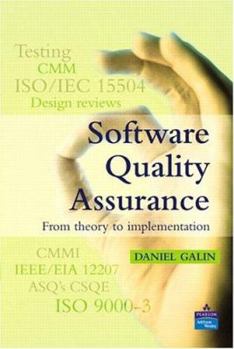
Hardcover Software Quality Assurance: From Theory to Implementation Book

ISBN: 0201709457

ISBN13: 9780201709452

Software Quality Assurance: From Theory to Implementation

Select Format

Select Condition ThriftBooks Help Icon

Recommended

Format: Hardcover

Condition: Good

$8.29
Save $131.70!
List Price $139.99
Almost Gone, Only 2 Left!

Book Overview

Software quality assurance (SQA) systems are vital for software developers in the software and the electronics industries as well as for information systems divisions in organizations. This book, based on many years of consulting and teaching experience, is designed to serve three audiences: students at universities and colleges, participants in vocational training courses in the industry and practitioners/professionals. Each chapter will conclude with commonly raised questions, problems, short case studies, and topics for discussion. The methodology to be presented in the book conforms with the requirements of ISO 9000 standards (ISO 9001 Quality Management and Quality Assurance Standard and of ISO 9000-3 Guidelines for the Application of ISO 9001 to the Development, Supply, Installation and Maintenance of Computer Software). The topics that will be covered will conform with the requirements of most vocational training programs (e.g.. the American Society for Quality's training program for Certified Software Quality Engineers). The book is designed to include in its appendices a collection of useful templates and checklists containing items of great interest to practitioners and students, and is accompanied by an Instructor's Solutions Manual and PowerPoint Slides.

Customer Reviews

2 ratings

emphasis on metrics to gauge progress

Galin explains why software is usually far harder to test than hardware. The latter usually only has a few modes of operation, thousands at most. While the combinatorics of any nontrivial software package can easily produce millions of modes. Also, hardware defects (like parts missing) are often easy to detect by visual inspection. While software is often inherently opaque. It might have a corrupted or missing module that might not be found until the customer tries to use it. This is exacerbated by bugs being found essentially mostly in development and testing. And not in manufacturing. This latter step is trivial is software, but is the key step in hardware. His book then goes over the main types of Software Quality Assurance models. These might already be familiar to you. The Waterfall model, which forms the basis of most SQA standards. But for small software projects, you might be able to use the Prototyping model, which can be faster. If you have a complex project, then maybe try the Spiral model. Here the spiral is a useful metaphor that indicates a hopeful convergence of the project at the centre of a Spiral chart. Then there is the Object Oriented model. Which takes its inspiration from the rise of OO languages like C++ and Java. As you build up a library of classes, then the more useful this model becomes, at the project level. Each of the above models is concisely explained. The entire book has this flavour. With a continual emphasis on metrics, as these are crucial to permitting an objective assessment of your project. In some ways, without taking sides as to which model you might adopt, the book seems to suggest that doing the metrics may be at least as important. So that you get some tangible idea of how your project is progressing. It is also nice to see that he gives no mention of Extreme Programming. This is a dead end that was briefly popular amongst some developers, until its disadvantages became apparent. The book is structured somewhat like a textbook, with questions at the end of each chapter. Certainly useful in focusing your attention. But its usage as an actual text in a university course seems unlikely. Not due to any failing in the book. But simply that computer science departments rarely teach this topic in any detail. Mostly left to industry.

Solid college text + real world reference

Although written as a college text (the publisher also has instructor manual, syllabus and discussion guidelines, and test material), this book sufficiently reflects real world SQA to be used by working practitioners. My review focus is on the latter use. Chapters that will be of interest to real world SQA include Chapter 3. Software Quality Factors (excellent foundation for a metrics initiative), Chapter 5. Contract Review (checklists for proposal and contract review are excellent), Chapters 7 (Integrating Quality Activities in the Project Life Cycle - especially the model for SQA defect removal effectiveness and cost) and 8 (Reviews, which includes supporting templates), and Chapter 11. Assuring The Quality of Software Maintenance, which is an often overlooked aspect of SQA.Note that this book has been written to support ISO 9001 and contains chapters that are specifically slanted towards that approach. Included are chapters on document and configuration control, auditing, and attaining ISO 9001 certification. The author also provides solid information on ISO/IEC Quality Assurance standards, IEEE/ANSI Standards, and MIL-STD-498, as well as on common assessment approaches (CMM and SPICE). As a textbook the coverage of every facet of SQA from why and what, to testing, metrics and its role in organizations and projects are thoroughly covered. The fact that the material is up-to-date and truly reflects the real world makes this one of the better texts for college level courses because it does prepare students for roles as practitioners.
Copyright © 2025 Thriftbooks.com Terms of Use | Privacy Policy | Do Not Sell/Share My Personal Information | Cookie Policy | Cookie Preferences | Accessibility Statement
ThriftBooks ® and the ThriftBooks ® logo are registered trademarks of Thrift Books Global, LLC

GoDaddy Verified and Secured