


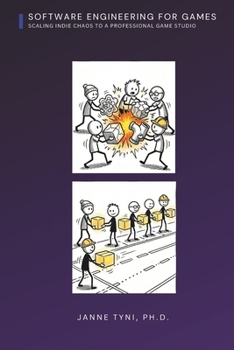
Software Engineering for Games: Scaling indie chaos to a professional game studio
No Customer Reviews

This book addresses the fundamental challenge facing every game developer who tran-
sitions from hobbyist experimentation to professional production: the shift from mak-
ing software work once to keeping software working indenitely. The gap between these
two modes of operationprototyping and engineeringrepresents the dierence between
code that demonstrates a concept and code that ships to millions of players without
catastrophic failure. Most game development education focuses on the creative and algorithmic aspects of im-
plementation: how to write a pathnding system, how to implement physics simulation,
how to structure gameplay logic. These skills are necessary but insucient. Professional
game engineering requires mastery of an additional dimension: the systematic practices
that ensure code remains maintainable, performant, and correct as team size scales from
one developer to fty, as codebase size grows from thousands of lines to millions, and as
project duration extends from weeks to years. This text teaches game engineering as a discipline distinct from game programming.
Game programming answers the question: How do I implement this feature? Game
engineering answers the question: How do I implement this feature in a way that does
not make the next feature exponentially harder to implement? The former is a local
optimization problem. The latter is a global optimization problem requiring systematic
methodology.
sitions from hobbyist experimentation to professional production: the shift from mak-
ing software work once to keeping software working indenitely. The gap between these
two modes of operationprototyping and engineeringrepresents the dierence between
code that demonstrates a concept and code that ships to millions of players without
catastrophic failure. Most game development education focuses on the creative and algorithmic aspects of im-
plementation: how to write a pathnding system, how to implement physics simulation,
how to structure gameplay logic. These skills are necessary but insucient. Professional
game engineering requires mastery of an additional dimension: the systematic practices
that ensure code remains maintainable, performant, and correct as team size scales from
one developer to fty, as codebase size grows from thousands of lines to millions, and as
project duration extends from weeks to years. This text teaches game engineering as a discipline distinct from game programming.
Game programming answers the question: How do I implement this feature? Game
engineering answers the question: How do I implement this feature in a way that does
not make the next feature exponentially harder to implement? The former is a local
optimization problem. The latter is a global optimization problem requiring systematic
methodology.
Format:Paperback
Language:English
ISBN:B0GW7DWPWM
ISBN13:9798252344287
Release Date:April 2026
Publisher:Independently Published
Length:152 Pages
Weight:0.47 lbs.
Dimensions:0.3" x 6.0" x 9.0"
Customer Reviews
0 rating
Copyright © 2026 Thriftbooks.com
Terms of Use | Privacy Policy | Do Not Sell/Share My Personal Information | Cookie Policy | Cookie Preferences | Accessibility Statement
ThriftBooks ® and the ThriftBooks ® logo are registered trademarks of Thrift Books Global, LLC
ThriftBooks ® and the ThriftBooks ® logo are registered trademarks of Thrift Books Global, LLC
