


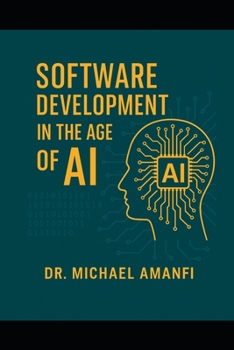
Software Development in the Age of AI
No Customer Reviews

This comprehensive guide reframes artificial intelligence not as a threat to software developers but as a powerful amplifier that fundamentally redefines their role. The modern development environment has evolved from reactive to anticipatory, with AI copilots like GitHub Copilot and Amazon CodeWhisperer transforming coding from a solitary craft into a collaborative partnership. Rather than replacing developers, AI shifts their focus from pure coding to becoming curators, strategists, and accountability stewards who validate AI contributions and ensure system sustainability. This human AI collaboration creates a hybrid intelligence that dramatically shortens development cycles while demanding new forms of transparency, rigorous oversight, and adapted team workflows. The book positions this relationship as pair programming at scale, where humans provide intent, judgment, and ethical oversight while AI delivers speed, pattern recognition, and comprehensive scope. Despite AI's capabilities, mastering programming fundamentals remains crucial for evaluating AI outputs, detecting design flaws, and maintaining system integrity. The book emphasizes that concepts like abstraction, data structures, and algorithmic complexity aren't obsolete but essential for preventing developers from becoming mere AI operators. A critical new competency is prompt engineering, the art of writing precise, structured prompts that yield context-aware outputs, which the book treats as a new form of programming literacy. While AI assists with code generation, debugging, testing, and architecture scaffolding, developers must validate all outputs and retain ownership of design decisions. The job market now values AI literacy as a core competency, with new roles emerging, such as prompt engineers and AI auditors. Evaluation criteria have shifted from syntax mastery to adaptability, creativity, and ethical awareness, making soft skills like communication and systems thinking crucial advantages. The central thesis is that success in the AI era isn't measured by lines of code written but by the ability to harness intelligent tools to create sustainable, ethical, and user-centered systems. Developers are evolving into orchestrators of hybrid intelligence who balance innovation with responsibility. The book champions continuous learning beyond traditional computer science, exploring design, psychology, and ethics, as these human-entered skills become more valuable as AI handles routine tasks. By mastering fundamentals, embracing AI collaboration, and maintaining a growth mindset, software engineers can shape technology's future in ways that reflect human values and imagination, focusing on higher-order thinking and system design while AI handles implementation details.
Format:Paperback
Language:English
ISBN:B0FPDC1Z6S
ISBN13:9798263176853
Release Date:September 2025
Publisher:Independently Published
Length:522 Pages
Weight:1.59 lbs.
Dimensions:1.1" x 6.1" x 9.2"
Customer Reviews
0 rating
Copyright © 2026 Thriftbooks.com Terms of Use
| Privacy Policy | Do Not
Sell/Share My Personal Information | Cookie Policy | Cookie Preferences | Accessibility Statement
ThriftBooks® and the ThriftBooks® logo are registered trademarks of Thrift Books Global, LLC
ThriftBooks® and the ThriftBooks® logo are registered trademarks of Thrift Books Global, LLC
