


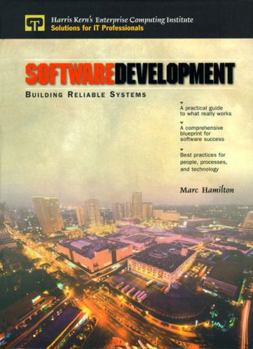
Hamilton: Software Dev Bldg Rel _p


There's never been a more thorough, realistic guide to "what works" in software development -- and how to make it happen in your organization. In this book, a leading consultant presents the... This description may be from another edition of this product.
Format:Paperback
Language:English
ISBN:0130812463
ISBN13:9780130812469
Release Date:January 1999
Publisher:Prentice Hall
Length:357 Pages
Weight:2.30 lbs.
Dimensions:1.3" x 7.1" x 9.5"
Customer Reviews
4 ratings
Best suited to internal IT/IS - technology section is weak
Published by Thriftbooks.com User , 23 years ago
The excellent previous comments by Per Kisler and Linda Zarate sum up this book from a general software engineering perspective. The main value of this book, in my opinion, is that the material addresses internal IT/IS software development more than product-line development or software engineering environments.If you are seeking guidance on organizing an MIS development group this book is an excellent resource, especially with respect to organization and processes. If your are more interested in development from a product-line or software engineering perspective I recommend "Successful Software Development" by Scott E. Donaldson and Stanley G. Siegel (ISBN 0130868264).For MIS development this book benefits from the extensive experience of Harris Kern (who is the Enterprise Computing series editor of which this book is a part), and the focus in IT/IS organizational and process factors. In fact, this book is particularly strong in the way it integrates IT/IS operations and management organization and process with software development. I especially like the emphasis on people and process, but like others who have previously commented I feel that the parts of this book that address technology are weak and should be eliminated from any subsequent edition.The sections on developer recruiting and retention are especially well done, and the issues and factors of integrating processes are discussed in detail, making this an invaluable resource for the right audience.
Overview of software development
Published by Thriftbooks.com User , 24 years ago
Slightly outdated overview of nearly all aspects of software development with strong emphasis on Java. The book assumes no previous knowlegde of software engeneering and shows the reader step by step of what elements software development consists. The spectrum of topics spans a range from recruiting the right people to explaining the workings of CORBA. This wide range of topics implies not going very deep into each one. So one needs to read many additional books about each topic covered here. While dealing with Java and Jini the author could not forsee the new moves of Microsoft with it's .NET technology. So it would be interesting how the author would write about it today. Definitely outdated are the listings of software products, e.g. IDE's. Missing are a lot of necessary diagrams for showing how to modell, communicate or visualize the software development process. Overall the book serves as a handy introduction to software development, giving one the feeling, that one has now heard about all the relevant aspects involved in it.
Good overview of people & processes; weak on technology
Published by Thriftbooks.com User , 25 years ago
I read this book because a colleague recommended it as a good introduction to the software development process. My goals were to gain more insights into the development process as it pertains to applications delivery, and to integrate this information in to production acceptance criteria. Since I have read (and reviewed) a number of books in the Enterprise Computing Institute series my expectations regarding format and depth of content were set in advance. In this respect I was not disappointed.Like most books in the series Software Development is sequenced in a specific order: background, people, process and technology. It is also follows the series formula of hitting a wide number of topics without going into much detail. It starts with background and a good, but basic, discussion of critical success factors (the authors call them the "Ten Commandments of Software Development", and current trends. The People part of the book contained some development-specific information on teams and organization, and some fairly generic material on recruiting and retaining talent. The highlight of this book in the section on processes. I gained a lot of insights about the stages in the development life cycle and an overview of rapid application development. What stood out here were the chapters on productivity, metrics and quality, and web-centric production acceptance. Since I was seeking information that would provide a foundation for production acceptance finding it in the book was a nice surprise. What I found least informative or valuable was the section on technology. I thought the chapter on programming language features did not fit into a book that was written as a high-level survey of development. Nor did I find the Java coding standard template in appendix A to be particularly useful. Although, to be fair, it may be of interest to a development manager who is seeking to develop and implement standards within his or her organization. However, the chapters on component-based software development and developing for the web were insightful and interesting. Overall this is a good, lightweight introduction to the software development process, and is well suited for managers and those of us in production support roles who need to understand this process in order to more closely work with developers. I subtracted a star because the technology section as a whole was disjointed, and the subtitle, "Building Reliable Systems" is misleading. While a sound development process will foster the development of reliable systems, there was no direct linkage between this obvious fact and the material in the book.
Most valuable for small teams that are growing
Published by Thriftbooks.com User , 25 years ago
If you are looking for a book that will discuss how to code, this is not the book for you. This book is more for a software development manager/director and architect.If you are reorganizing or creating a small to mid sized software development organization/team and you are trying to structure the team, setup job descriptions, document the software development process, and review some technology options, get this book. The book doesn't go into depth in all of these areas, so it won't answer all of your questions regarding managing a software development organization. However, it covers the important issues to address regarding people, processes, and technology. If you work for a large development organization, you probably have an established architecture, methodology, process, tools, and technology in place. The book would still be helpful in providing some best practice suggestions on how to improve your process or fill any gaps. I believe the book is most valuable for small teams that are growing and need to better organize their team(s) and formalize their processes for developing software and managing the people on their teams.
Copyright © 2026 Thriftbooks.com Terms of Use
| Privacy Policy | Do Not
Sell/Share My Personal Information | Cookie Policy | Cookie Preferences | Accessibility Statement
ThriftBooks® and the ThriftBooks® logo are registered trademarks of Thrift Books Global, LLC
ThriftBooks® and the ThriftBooks® logo are registered trademarks of Thrift Books Global, LLC
