


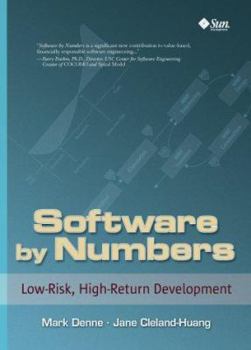
Software by Numbers: Low-Risk, High-Return Development

Denne, a business manager for a big software company, and Cleland-Huang apply ideas in application development methodologies to achieving financial rather than technological benefit. This description may be from another edition of this product.
Format:Paperback
Language:English
ISBN:0131407287
ISBN13:9780131407282
Release Date:October 2003
Publisher:Prentice Hall PTR
Length:208 Pages
Weight:0.79 lbs.
Dimensions:0.5" x 7.0" x 9.3"
Customer Reviews
5 ratings
Add rigor to modern development methods
Published by Thriftbooks.com User , 21 years ago
This book hopefully is the atomic bomb that will destroy the remaining methodologies that insist on treating software development like a manufacturing process. Software development is not manufacturing, nor is it construction, nor is it "just" engineering. It is precisely "development", as in product development. It is a mix of economics, science, art, engineering, and craft. It is "knowledge work", and therefore cannot be optimized by critical path analysis, scientific management techniques, or formal method compliance. The above, however, is no excuse for a lack financial discipline and rigor in the business case. Most modern approaches have no concept of finances and costs, nor do they apply cost/benefits analysis to the ordering of features. This was to be the responsibility of the "customer", but sadly, they're as human as the developers, and are only familiar with the old tried-and-true WBS time/cost projections. Negotiated-scope contracts are only a partial solution to this problem. Many executives want to get an understanding of their discounted cash flow projections vs. "total spend" over an arbitrary period. They need to ensure they are achieving an appropriate return for the capital commitment. This book's incremental funding method enables you to budget, sequence, risk-adjust, and NPV-optimize every marketable user story or bundle of use cases over a set period. It will enable you to ROI-justify your software architecture and evolve it instead of sinking costs into it up-front. It will show to non-technical executives the true benefits of agile development: faster time-to-revenue, projects that rapidly self-fund, quicker break-even points, and smaller up-front investments. In short, this book is an indispensible means to sell the breakthrough productivity of agile methods.
Ground-breaking
Published by Thriftbooks.com User , 22 years ago
"Software by Numbers" is yet another book I would like any manager involved in my working life to read and re-read.The authors describe an Incremental Funding Method (IFM) for scheduling incremental development of software which optimizes the Return on Investment (ROI) by having the requirements engineered into Minimum Marketable Features (MMF) with concrete, monetary value.The book is very light (less than 200 pages) but packed with interesting material. I read most of the book during a flight from Finland to Germany and finished the book on my way home. Despite the minimal page count, the authors manage to explain why their method is desperately needed and how it fits to existing software processes such as RUP and XP. They also describe the business case for incremental architecture and different strategies for sequencing MMFs and Architectural Elements (AE) for maximum ROI over the project's lifetime.The only downside I found for this book is that I would've needed some more baby-steps support for the actual calculations (sequence-adjusted net present values etc.). I'm sure others will be hoping to see some more real world examples of feature deconstruction and sequencing as well. On the other hand, I really appreciate the fact that the authors made the effort of putting up a spreadsheet online for supporting their method.Overall, an excellent book. Highly recommended.
Excellent approach to maximize IT business impact
Published by Thriftbooks.com User , 22 years ago
For the past five years I have been a consultant, helping companies analyze the link between the products they buy and the financial impact those products make on their businesses. During that time I've poured over numerous books on the subject of ROI and tried to make sense of them in the context of real world environments. Most books fail to make a contribution to real world problems because they are typically too academic, unrealistic or they are too vague.However, I'm very impressed with this book.This book clearly outlines an excellent, flexible methodology for real world technology resource management that MAXIMIZES BUSINESS IMPACT. It's different from other approaches I've seen in the past. I can tell from the authors' examples and analysis that there is a real synthesis between disciplined academic approach and real life project management. Even after five years of study, there were a lot of new ideas that I hadn't seen elsewhere.I think this book applies to a wide audience within IT development. CIOs can gain a lot of ground from reading this book and instilling this approach across their organization. Technology managers who have come up the ranks from being smart technicians MUST read this book to take the leap from coder to business manager. Business analysts ought to read this book to optimize their tradeoff of features and functions versus resources. I think that if my clients embraced the approach in this book, they'd see a lot of cash crunch problems disappear. I recommend it to all of them.
A must-have for product-based organizations too
Published by Thriftbooks.com User , 22 years ago
I picked up this book based on the recommendation of a collegue,and found the information invaluable. I work in a product-based IT organization, and these concepts are very helpful for mature product release planning and budgeting, which was a missing element at my company. I am not sure about the comments from the previous reviewer saying the book is based on a flawed premise that "you know the costs and time frame for development to a high degree of accuracy for every available option." It is explicitly stated in the book several times that estimation, not perfection, is the key and perfect-world scenarios don't exist. The authors even say that due to potential and probable changes in cost and time estimation, market conditions, etc. that one should revisit MMF sequencing at the start of each period anyway. Also, the website of the book, http://www.softwarebynumbers.org, explains about accurate projections in the FAQ section. Overall, a very useful tool!
Optimize the order you develop features, overall project ROI
Published by Thriftbooks.com User , 22 years ago
In Software by Numbers: Low-Risk, High-Return Development, authors Mark Denne and Jane Cleland-Huang define an Incremental Funding Methodology (IFM). Building on the major post-waterfall methodologies - Agile and RUP - which call for development based on iterations, Denne and Cleland-Huang urge looking at those iterations as Minimum Marketable Features (MMFs) - which a colleague refers to as "the memes of software development". Based on the notion that software is never complete, IFM offers unique opportunity for product managers and developers to collaborate to find the earliest sequence of MMFs for returns that match the project's optimal goals. The authors walk through how to calculate ROI, NPV (net present value) and sequence-adjusted NPV (what's its NPV if you don't start the feature until February) of individual MMFs; and show how to prioritize and order a project based on return so it can become self-funding earliest. I've been managing software development for 15 years, and for much of it looking for ways to better engage the development and business sides with each other to raise the level of teamwork. IFM offers new opportunity to do so. Putting dollar values on individual features gives product managers the means to add value to feature ordering -- to provide real world input into a process often done by developers alone, optimizing the sequencing of features they develop based solely on gut feel. If they score - if they get the optimum sequencing right - they've enabled earliest delivery of both a marketable product and each of the follow-on versions. I might consider, to introduce IFM to a project team, a set of weekly brownbags for product managers and developers alike to work through an understanding, chapter by chapter, of how to optimize their project. Five stars for bringing new (and very useful!) thinking to the methodology discussion.-- Ron Lichty
Copyright © 2026 Thriftbooks.com
Terms of Use | Privacy Policy | Do Not Sell/Share My Personal Information | Cookie Policy | Cookie Preferences | Accessibility Statement
ThriftBooks ® and the ThriftBooks ® logo are registered trademarks of Thrift Books Global, LLC
ThriftBooks ® and the ThriftBooks ® logo are registered trademarks of Thrift Books Global, LLC
