


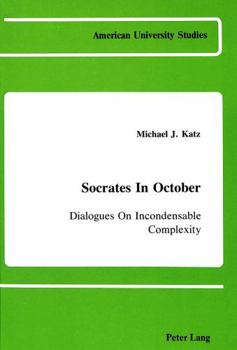
Socrates in October: Dialogues on Incondensable Complexity
No Customer Reviews

Socrates has come to represent the pure joy of intellectual inquiry, and the Socratic dialogue embodies a special style of logical inquiry and also a clear framework of philosophical information. The intellectual grandfather of Plato's student Aristotle, Socrates still lived at a time when the distinctions between physical science and psychology, linguistics and aesthetics, mathematics and rhetoric were not rigid fences: all philosophical attacks were fair weaponry when trying to understand a problem. In 399 B.C., philosophers could not blithely speak in the language of modern science - using space-time continua or four dimensions or relativistic frames of reference or genetic codes to hide innumerable elemental assumptions about the nature of human understanding. Moreover, Socratic philosophy was always centered around people. Instead of a dense constructure of interlaced and multilayered scientific concepts, Socrates had only his hands and his feet, and the trees, the houses, the mountains, and all the people in the Agora, the marketplace of Athens. Michael Katz has taken advantage of Socrates' world - his style, his perspective, his times, and some of his important themes - to explore the perpetual problem of complexity: Is our world incondensably complex? If so - where and why? And, what does this mean for the kinds of understandings with which we must be satisfied?
Format:Hardcover
Language:English
ISBN:0820405442
ISBN13:9780820405445
Release Date:September 1991
Publisher:Peter Lang Inc., International Academic Publi
Length:215 Pages
Customer Reviews
0 rating
Copyright © 2026 Thriftbooks.com Terms of Use
| Privacy Policy | Do Not
Sell/Share My Personal Information | Cookie Policy | Cookie Preferences | Accessibility Statement
ThriftBooks® and the ThriftBooks® logo are registered trademarks of Thrift Books Global, LLC
ThriftBooks® and the ThriftBooks® logo are registered trademarks of Thrift Books Global, LLC
