


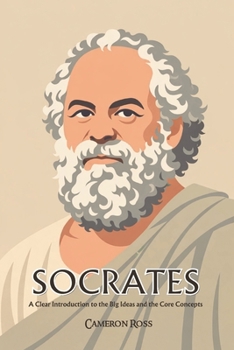
Socrates: A Clear Introduction to the Big Ideas and the Core Concepts

Socrates leaves no writings, yet few figures have shaped philosophy so completely. What survives is a life lived under examination, exposed in conversation, sustained by questioning rather than assertion. In the public spaces of Athens, Socrates confronts confidence with inquiry, reputation with reason, and inherited certainty with doubt that refuses cynicism.
His philosophy unfolds as practice rather than doctrine. To question is not to destroy but to test, to uncover whether one's beliefs can withstand scrutiny when stripped of habit and authority. This insistence makes Socrates unsettling. He does not offer comfort or instruction, only responsibility. Knowledge becomes inseparable from character, and ignorance from moral risk.
The tension at the heart of Socratic life lies between loyalty to reason and loyalty to the city. Socrates challenges power yet submits to the law that condemns him, refusing escape without retreating from critique. His death is not a spectacle of martyrdom but a final act of coherence.
Socrates endures because he leaves philosophy unfinished, demanding participation rather than assent. To encounter him is to face a question that does not fade: whether a life unexamined can truly be lived at all.
What you will find in this book:Understanding Socrates through dialogue, not doctrine
This book explains why Socrates left no written works and how his philosophy survives through dialogue, questioning, and confrontation. You will discover how his method resists fixed doctrines and instead trains the mind to examine beliefs, expose contradictions, and pursue clarity through conversation.
The Socratic method as a tool of critical thinking
You will explore the structure and purpose of Socratic questioning: irony, refutation, and disciplined inquiry. The book shows how this method dismantles false certainty and encourages intellectual humility, making philosophy an active practice rather than a system of answers.
Ethics, virtue, and the examined life
This section clarifies Socrates' central ethical claim: that virtue is inseparable from knowledge and that an unexamined life is not worth living. You will understand how moral responsibility depends on self-knowledge, rational reflection, and care for the soul.
Socrates versus the city: trial, condemnation, and death
The book reconstructs the trial of Socrates, explaining why his questioning threatened Athenian norms and authority. You will see how his refusal to compromise reveals a radical commitment to truth, conscience, and philosophical integrity.
The enduring legacy of Socratic philosophy
This book shows how Socrates shaped Western thought by redefining philosophy as a way of life. You will understand his influence on Plato, Aristotle, ethics, education, and the very idea that reasoned inquiry is a moral duty.
Add this book to your cart now to discover why Socrates remains the defining figure of philosophy as lived inquiry rather than abstract theory.
Related Subjects
PhilosophyCustomer Reviews
ThriftBooks® and the ThriftBooks® logo are registered trademarks of Thrift Books Global, LLC
