


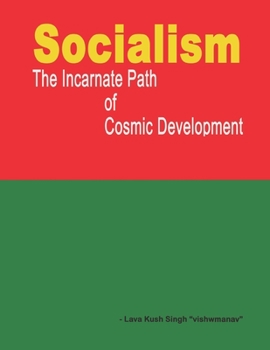
Socialism - the incarnate path of cosmic development
No Customer Reviews

Human civilization advances not merely through technological, economic, or political changes, but through those deeper ideological currents that continuously vibrate within individuals and flow through societies. Today, humanity stands at a historical crossroads: old systems have revealed their limitations, while the form of the new order has not yet fully emerged. In this transitional moment, the work "Socialism: The Incarnational Path of Cosmic Evolution" appears as an alternative stream of thought. It does not present socialism merely as a political doctrine; rather, it views the development of the individual, society, nation, and the entire cosmos as one unified process.
The foundation of this book rests on the understanding that there are two types of development-Asuric (demoniac) and Divine. This distinction does not arise from economic or social processes but from the direction of consciousness. Asuric development is rooted in external expansion, consumption, power, and domination, whereas Divine development flows from the soul, equanimity, selfless action, and the welfare of all beings. Numerous Vedic and historical references in the document-such as Vidura Nīti and descriptions from the Vedas-make it clear that the highest aim of ancient Indian philosophy was always a society based on oneness, where the individual and the collective are not in conflict but are two expressions of the same cosmic law.
The personalities cited throughout the text-Gandhi, world leaders, national thinkers-reinforce the notion that the future development of humanity can ultimately stand only upon truth, selflessness, unity, and universal welfare. Gandhi's statement, "Truth is God," for instance, directly links personal spiritual evolution with social progress. Similarly, the voices of many global leaders indicate that the world today is searching for a model capable of transforming diversity from a source of conflict into a source of harmony.
A key feature of this book is that it does not treat socialism as a mere economic theory, but proclaims it as the incarnational path of human evolution aligned with cosmic laws. Here, "incarnation" does not refer to miraculous power but to the emergence of a higher consciousness that leads humanity toward "unitary action" and "unitary love"-a state which, in the document, is described as the human expression of the Vishnu principle.
The text presents a comprehensive model of organization-from the village level to the nation and onward to the world-where governance, economics, education, agriculture, civic life, security, and culture rise from the bottom upward. At the rural level, principles such as Atithi Devo Bhava, local storage systems, transparency in civic processes, and self-sufficient panchayat structures form the practical components of this broader vision.
The ultimate aim of this entire framework is to build an evolved India where citizens are not merely consumers or voters, but enlightened, educated, ethical, and globally-conscious human beings. Recurrent terms throughout the document-light, age-transformation, developed India, world constitution, a new alternative-point unmistakably in this direction. Ultimately, this book is not merely an idea-it is an invitation.
The foundation of this book rests on the understanding that there are two types of development-Asuric (demoniac) and Divine. This distinction does not arise from economic or social processes but from the direction of consciousness. Asuric development is rooted in external expansion, consumption, power, and domination, whereas Divine development flows from the soul, equanimity, selfless action, and the welfare of all beings. Numerous Vedic and historical references in the document-such as Vidura Nīti and descriptions from the Vedas-make it clear that the highest aim of ancient Indian philosophy was always a society based on oneness, where the individual and the collective are not in conflict but are two expressions of the same cosmic law.
The personalities cited throughout the text-Gandhi, world leaders, national thinkers-reinforce the notion that the future development of humanity can ultimately stand only upon truth, selflessness, unity, and universal welfare. Gandhi's statement, "Truth is God," for instance, directly links personal spiritual evolution with social progress. Similarly, the voices of many global leaders indicate that the world today is searching for a model capable of transforming diversity from a source of conflict into a source of harmony.
A key feature of this book is that it does not treat socialism as a mere economic theory, but proclaims it as the incarnational path of human evolution aligned with cosmic laws. Here, "incarnation" does not refer to miraculous power but to the emergence of a higher consciousness that leads humanity toward "unitary action" and "unitary love"-a state which, in the document, is described as the human expression of the Vishnu principle.
The text presents a comprehensive model of organization-from the village level to the nation and onward to the world-where governance, economics, education, agriculture, civic life, security, and culture rise from the bottom upward. At the rural level, principles such as Atithi Devo Bhava, local storage systems, transparency in civic processes, and self-sufficient panchayat structures form the practical components of this broader vision.
The ultimate aim of this entire framework is to build an evolved India where citizens are not merely consumers or voters, but enlightened, educated, ethical, and globally-conscious human beings. Recurrent terms throughout the document-light, age-transformation, developed India, world constitution, a new alternative-point unmistakably in this direction. Ultimately, this book is not merely an idea-it is an invitation.
Format:Paperback
Language:English
ISBN:B0BD2N38YS
ISBN13:9798351865157
Release Date:September 2022
Publisher:Independently Published
Length:248 Pages
Weight:1.29 lbs.
Dimensions:0.5" x 8.5" x 11.0"
Customer Reviews
0 rating
Copyright © 2026 Thriftbooks.com Terms of Use
| Privacy Policy | Do Not
Sell/Share My Personal Information | Cookie Policy | Cookie Preferences | Accessibility Statement
ThriftBooks® and the ThriftBooks® logo are registered trademarks of Thrift Books Global, LLC
ThriftBooks® and the ThriftBooks® logo are registered trademarks of Thrift Books Global, LLC
