


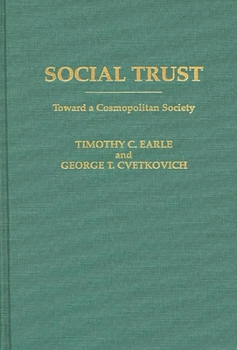
Social Trust: Toward a Cosmopolitan Society
No Customer Reviews

This work examines the basic social-psychological problems that generate the need for social trust and other acculturation strategies. Social trust is examined within the context of competing social problem-solving tools. The authors analyze the problem of how social trust can be encouraged within a cultural context that favors other socialization strategies, particularly distrust. They look at the relation between social trust and risk communication, specifically how social trust might be used to transform public participation; from an ineffective formalist show into a creative, community-building, problem-solving process. The work distinguishes between two forms of social trust pertinent to our world today: pluralistic, which occurs within groups and is based on existing values, and cosmopolitan, which is an across-group phenomenon and is based on emerging values. Earle and Cvetkovich's study is the story of gradual movement from pluralistic to cosmopolitan social trust.
Format:Hardcover
Language:English
ISBN:0275948455
ISBN13:9780275948450
Release Date:July 1995
Publisher:Praeger
Length:240 Pages
Weight:1.12 lbs.
Dimensions:0.6" x 6.1" x 9.2"
Customer Reviews
0 rating
Copyright © 2026 Thriftbooks.com
Terms of Use | Privacy Policy | Do Not Sell/Share My Personal Information | Cookie Notice | Cookie Preferences | Accessibility Statement
ThriftBooks ® and the ThriftBooks ® logo are registered trademarks of Thrift Books Global, LLC
ThriftBooks ® and the ThriftBooks ® logo are registered trademarks of Thrift Books Global, LLC
