


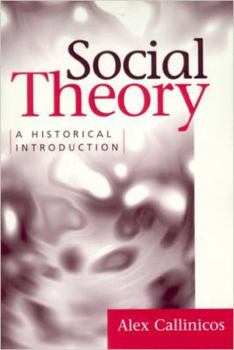
Social Theory: A Historical Introduction
No Customer Reviews

Select Format
Select Condition 
Book Overview
The eighteenth-century Enlightenment saw the birth of an era which sought legitimacy not from the past but from the future. No longer would human beings invoke the authority of tradition; instead, modern societies emerging in the West justified themselves by their success at increasing, through the application of scientific knowledge, human control over the world. Ever since this notion of modernity was formulated it has provoked intense debate. In this wide-ranging historical introduction to social theory, Alex Callinicos explores the controversies over modernity and examines the connections between social theory and modern philosophy, political economy and evolutionary biology. He offers clear and accesssible treatments of the thought of Montesquieu, Adam Smith and the Scottish Enlightenment, Hegel, Marx, Tocqueville, Maistre, Gobineau, Darwin, Spencer, Kautsky, Nietzsche, Durkheim, Weber, Simmel, Freud, Lukacs, Gramsci, Heidegger, Keynes, Hayek, Parsons, the Frankfurt School, Levi-Strauss, Althusser, Foucault, Habermas and Bourdieu, and concludes by surveying the state of contemporary social thought. A remarkably comprehensive and lucid primer, Social Theory is essential reading for students of politics, sociology and social and political thought.
Format:Paperback
Language:English
ISBN:081471594X
ISBN13:9780814715949
Release Date:September 1999
Publisher:NYU Press
Length:1 Pages
Weight:1.32 lbs.
Dimensions:9.0" x 1.0" x 6.0"
Customer Reviews
0 rating
Copyright © 2026 Thriftbooks.com
Terms of Use | Privacy Policy | Do Not Sell/Share My Personal Information | Cookie Notice | Cookie Preferences | Accessibility Statement
ThriftBooks ® and the ThriftBooks ® logo are registered trademarks of Thrift Books Global, LLC
ThriftBooks ® and the ThriftBooks ® logo are registered trademarks of Thrift Books Global, LLC
