


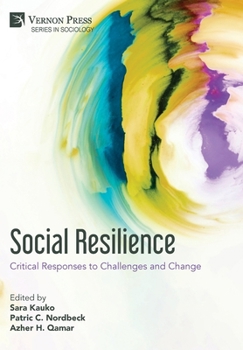
Social Resilience: Critical Responses to Challenges and Change

'Social Resilience: Critical Responses to Change and Challenges' is an edited volume intended for researchers and post-graduate students interested in studying social resilience from a multi-disciplinary, social scientific perspective. The volume consists of eight chapters that explore the concept from diverse disciplinary angles employing different theoretical and methodological approaches. Representing the fields of psychology, anthropology, social work, sociology of law, and legal studies, the authors discuss how social resilience manifests in different circumstances and contexts and what it means both in theory and practice. Thematically, these discussions concern migration, sexual minority experiences, environmental and economic crises, and the relationality and processuality of the concept as both an analytical tool and a unit of analysis in and of itself.
Most research on social resilience follows the socio-ecological systems paradigm that defines (social) resilience as an 'adaptive capacity' to cope with and overcome adversities. While some chapters in this book adhere to this, others advocate for a more process-oriented and dynamic approach, focusing not so much on how people build resilience but rather how people act across time and space and in relation to others when facing disruptions to normalcy or outstanding crises. Here, the volume offers a tacit critique of the neoliberal model of conceptualizing resilience as a normative concept; an ideal way to be, and explains what research on resilience might look like if it instead centers on our continuous being.
Customer Reviews
ThriftBooks ® and the ThriftBooks ® logo are registered trademarks of Thrift Books Global, LLC
