


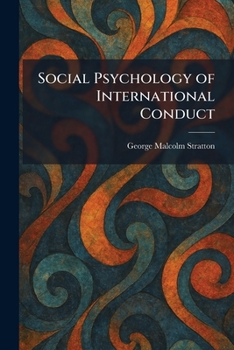
Social Psychology of International Conduct

Select Format
Select Condition 
Book Overview
"Social Psychology of International Conduct" explores the intricate psychological foundations that govern the behavior of nations and the possibilities for establishing a more peaceful global order. George Malcolm Stratton provides a systematic analysis of the mental and emotional forces driving international relations, moving beyond traditional political theory to examine the underlying human factors that shape global interactions.
The work investigates the origins of national prejudice, the psychological impact of war, and the human desire for collective security. Stratton discusses how nations perceive one another and how these perceptions-often rooted in instinct and deep-seated social habits-can either lead to devastating conflict or be redirected toward constructive international cooperation. He emphasizes the role of education and the development of international law as essential tools to modify behavior on a global scale.
This volume serves as a significant historical text in the application of social psychology to the field of international relations. It offers valuable insights into the search for a scientific basis for peace, making it an essential read for scholars of psychology, political science, and history. Stratton's rationalist approach highlights the urgent need for a psychological understanding of the global community to ensure the progress and stability of modern civilization.
This work has been selected by scholars as being culturally important, and is part of the knowledge base of civilization as we know it. This work was reproduced from the original artifact, and remains as true to the original work as possible. Therefore, you may see the original copyright references, library stamps (as most of these works have been housed in our most important libraries around the world), and other notations in the work.
This work is in the public domain in the United States of America, and possibly other nations. Within the United States, you may freely copy and distribute this work, as no entity (individual or corporate) has a copyright on the body of the work.
As a reproduction of a historical artifact, this work may contain missing or blurred pages, poor pictures, errant marks, etc. Scholars believe, and we concur, that this work is important enough to be preserved, reproduced, and made generally available to the public. We appreciate your support of the preservation process, and thank you for being an important part of keeping this knowledge alive and relevant.
Customer Reviews
ThriftBooks ® and the ThriftBooks ® logo are registered trademarks of Thrift Books Global, LLC
