


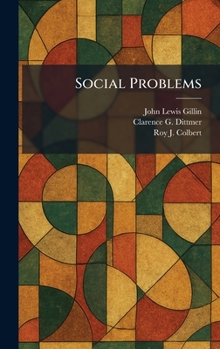
Social Problems

"Social Problems" is a foundational sociological exploration that addresses the complex challenges of modern civilization. Written by John Lewis Gillin, Clarence G. Dittmer, and Roy J. Colbert, this text serves as a thorough investigation into the social pathologies and maladjustments that characterized the early 20th century. The authors provide a structured analysis of diverse topics such as population growth, health, poverty, dependency, and the evolving nature of the family unit.
Throughout the work, there is a strong emphasis on the scientific study of society. By examining the environmental and biological factors that contribute to social distress, the creators aim to provide readers with a deeper understanding of the mechanisms behind crime, vice, and economic disparity. The text does not merely diagnose problems but also discusses the role of social institutions and policy in fostering progress and stability. As a significant contribution to the field of sociology, "Social Problems" reflects the era's commitment to social reform and the belief that intellectual inquiry could lead to the betterment of the human condition. It remains a valuable resource for those interested in the history of social thought and the development of public welfare systems.
This work has been selected by scholars as being culturally important, and is part of the knowledge base of civilization as we know it. This work was reproduced from the original artifact, and remains as true to the original work as possible. Therefore, you may see the original copyright references, library stamps (as most of these works have been housed in our most important libraries around the world), and other notations in the work.
This work is in the public domain in the United States of America, and possibly other nations. Within the United States, you may freely copy and distribute this work, as no entity (individual or corporate) has a copyright on the body of the work.
As a reproduction of a historical artifact, this work may contain missing or blurred pages, poor pictures, errant marks, etc. Scholars believe, and we concur, that this work is important enough to be preserved, reproduced, and made generally available to the public. We appreciate your support of the preservation process, and thank you for being an important part of keeping this knowledge alive and relevant.
Customer Reviews
ThriftBooks ® and the ThriftBooks ® logo are registered trademarks of Thrift Books Global, LLC
