


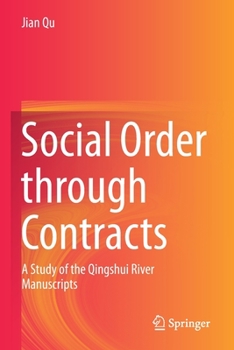
Social Order Through Contracts: A Study of the Qingshui River Manuscripts
No Customer Reviews

Select Format
Select Condition 
Book Overview
Abstract Dates and Currency I. Introduction 1. The story of the wealthiest 2. Research question: A contract society? 2.1. Economic success, social order, and contracts 2.2. The general puzzle of how and why the contract worked 3. Sources: The Qingshui River region and beyond 3.1. A brief introduction to the Qingshui River manuscripts and their studies 3.1.1. The discovery 3.1.2. Where and when?3.1.3. The content 3.1.4. Major collections, publications, and state of the field 3.2. Sources in and beyond the Region 3.2.1. Taking the Qingshui River manuscripts as the core source 3.2.2. Wendou, a cluster of villages, the region, and beyond 4. Synopsis and structure of this study II. Rediscovering Contract in the Qingshui River Region 1. Introduction: Standard and borderline contracts 1.1. A general and complex term 1.2. "Standard cases" and "borderline cases" 2. Contracts in law and practice 2.1. Contracts in contract laws 2.1.1. Defining contract in laws: A comparative approach 2.1.2. Contracts and the Great Qing Code 2.1.3. Contracts without contract law? 2.2. Categorization of contracts in everyday life 2.2.1. Contractual manuals 2.2.2. A necessary hypothesis 3. Contents of a contract: Beyond agreement i Table of Contents 3.1. The tense of a contract: Future or past? 3.2. The performance of contracts 3.2.1. Contracts need no performance 3.2.2. Producing contracts as the performance 3.3. Championing the past in the future 3.3.1. Negative obligations in the future tense 3.3.2. The established and confirmed 3.4. Transcending as an agreement 3.4.1. Contract without agreement? 3.4.2. Jural relations: An external observation 4. Identifying contracts by form: The internal and external 4.1. The textual form 4.1.1. Essential elements? The changing and unchanged 4.1.2. Specialized language and formulaic expressions 4.2. The ritual form 4.2.1. Customs of contracting 4.2.2. Textual reflections 4.3. The formulaic beginning of a contract: Indicating and integrating 4.3.1. The formula of the beginning 4.3.2. Integrating the form and content 4.3.3. The indicator as a shortcut 5. Paper matters: The materiality of contracts 5.1. The burning of contracts 5.1.1. The story of Yao the Millionaire 5.1.2. A contract of dispute settlement 5.2. The non-conceptual contract: The contract and its material carriers 5.2.1. The abstract and concrete contract 5.2.2. Material carriers other than paper 5.3. The validity of the material: Oral and non-original 5.3.1. Oral contracts5.3.2. Copies of the contract 6. Conclusion III. Middlemen1. Introduction: Understanding middlemen within a contract 2. The primary and the secondary: Formation and restoration 2.1. Four roles 2.2. Two levels 3. The primary: Introducers, witnesses, and guarantors 3.1. Introduction 3.1.1. Matchmaking and facilitation 3.1.2. Duzhong ii Table of Contents3.1.3. Hanzhong 3.2. Witnessing 3.3. Guarantee 4. The secondary: Arbitrators and peacemakers 4.1. The "original middleman" 4.2. Arbitration 4.2.1. Fact-finding 4.2.2. Reasoning 4.3. Mediation 5. The middleman as the th
Format:Paperback
Language:English
ISBN:9813349492
ISBN13:9789813349490
Release Date:February 2022
Publisher:Springer
Length:284 Pages
Weight:0.96 lbs.
Dimensions:0.7" x 6.1" x 9.2"
Related Subjects
Law Literary Criticism Literary Criticism & Collections Social Science Social SciencesCustomer Reviews
0 rating
Copyright © 2026 Thriftbooks.com Terms of Use
| Privacy Policy | Do Not
Sell/Share My Personal Information | Cookie Policy | Cookie Preferences | Accessibility Statement
ThriftBooks® and the ThriftBooks® logo are registered trademarks of Thrift Books Global, LLC
ThriftBooks® and the ThriftBooks® logo are registered trademarks of Thrift Books Global, LLC
