


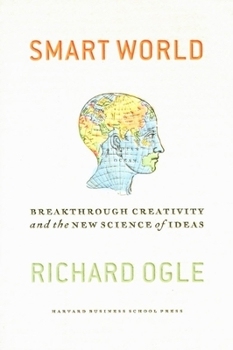
Smart World: Breakthrough Creativity and the New Science of Ideas

Select Format
Select Condition 
Book Overview
Since ancient times, people have believed that breakthrough ideas come from the brains of geniuses with awesome rational powers. In recent years, however, the paradigm has begun to shift toward the notion that the source of creativity lies "out there," in the network of connections between people and ideas. In this provocative book, Richard Ogle crystallizes the nature of this shift, and boldly outlines "a new science of ideas." The key resides in what he calls "idea-spaces," a set of nodes in a network of people (and their ideas) that cohere and take on a distinctive set of characteristics leading to the generation of breakthrough ideas. These spaces are governed by nine laws - illuminated in individual chapters with fascinating stories of dramatic breakthroughs in science, business, and art. "Smart World" will change forever the way we think about creativity and innovation.
Format:Hardcover
Language:English
ISBN:1591394171
ISBN13:9781591394174
Release Date:June 2007
Publisher:Harvard Business Review Press
Length:303 Pages
Weight:1.38 lbs.
Dimensions:1.2" x 6.5" x 9.2"
Customer Reviews
5 ratings
Applying the science of networks to creativity
Published by Thriftbooks.com User , 18 years ago
This is a strange, wonderful and not always easy book. Richard Ogle tackles a slippery question about the mind: Where do truly creative leaps originate? Studies of creativity and innovation are multiplying, but Ogle's book does something rare. It demonstrates how networking creates something new by navigating shared spaces. Its style and content will make it challenging to many readers. Though Ogle has a knack for original, striking phrases, a simpler style would have served the innate complexity of the subject matter. That aside, we recommend this book to everyone who is interested in innovation, creativity and the propagation of ideas through culture. The parallels Ogle draws among plastic dolls, Romantic paintings, the discovery of DNA and the development of the personal computer are striking and entertaining, and his concepts about how creativity uses "idea-spaces" and networks are wildly intriguing.
Excellent!
Published by Thriftbooks.com User , 19 years ago
I have been reading and re-reading this book for over two weeks. It is probably fair to say it's more than I bargained for - lots of fundamental reading here, which provides the foundations for the authors well-reasoned integration. My only humble suggestion to the author is that he provide a mindmap or a similar summary on his blog. That might be very useful for those who are interested in starting to applying his teachings. Great book that should be on everyone's nightstand!
New Tools for Understanding Creativity
Published by Thriftbooks.com User , 19 years ago
We are surrounded by human engineering, cultural artifacts, vast libraries, and accumulated knowledge that is doubling every two years. This human-built space -- a hive of meaning that we have created and now inhabit; a space that guides our thinking and our understanding of the world; a legacy inherited by every new generation -- has been called the "extended mind." This extended mind, Richard Ogle says, is nothing less than a "smart world" that enables creativity and provides the impetus for breakthrough innovation. Ogle introduces the concept of the "idea-space" -- a collection of knowledge, rules, paradigms, artifacts and assumptions that defines and guides a particular domain of human activity. When idea-spaces collide, Ogle says -- when we transfer ideas from one domain to another -- it's a catalyst for creativity. Idea-spaces can be visualized as small-world networks. Some lie close together, others further apart. When idea-spaces are most disparate, he says, the collision is more spectacular. There is a much greater likelihood of breakthrough innovation. Ogle provides examples of the collision of ideas from art, science, and Silicon Valley. All in all, this is a very good book, with many new tools for understanding the dynamics of creativity.
"Class pay attention--you'll learn something."
Published by Thriftbooks.com User , 19 years ago
In "Smart World" Richard Ogle sets out to probe, demystify and explain how creative minds work when major discoveries bubble up -- often in wildly unexpected places and by unknown entrepreneurs, artists and scientists. His tale blends history, science, sociology, linguistics and physics to tell of some major breakthroughs, including Gutenberg's printing press, Picasso's discovery of Cubism, how Watson & Crick uncovered DNA -- the twisting molecular structure that carries life's genetic blueprint, the personal computer explosion, architect Frank Gehry's dazzling Bilbao museum, and even the magical allure of a child's doll, Barbie. Along the way Ogle introduces what he calls "idea-spaces," "hotpockets," and "small-world networks" to show how tectonic shifts in knowledge take hold. Among his observations: some inventors succeed not by inventing from scratch, but by using bits of established ideas and then pushing that knowledge into a new direction that leads to a giant discovery. This method worked for Watson & Crick and for Gutenberg as well. Equally sharp is Ogle's explanation of how some potentially great ideas die -- Xerox's research team had a crackerjack PC design -- but a tiny rival, Apple, thanks to its founders Jobs and Wozniak, was better plugged into the critical hobbyist world, which in turn triggered the PC goldmine. Although Ogle's book, published by Harvard Business School Press, is obviously targeted for business readers desperate to find the next big product, his 263 pages (excluding footnotes, bibliography and index) are so rich in material that it's too good for just a narrow audience. "Smart World" is a smart book. Read it.
How to Achieve Creative Breakthroughs in a "Smart World"
Published by Thriftbooks.com User , 19 years ago
Although we recognize and appreciate the importance of the human mind's capability for breakthrough creativity (e.g. DNA, printing with movable type, the personal computer), Richard Ogle acknowledges, "the mental processes that led to them have remained largely beyond our grasp. Where do truly innovative ideas come from, and how does the mind make the leap to embrace them? What role do existing cultural and social factors play? Above all, what are the primary mental faculties involved in creativity, and how do they work?" These are among the questions to which Ogle responds in this volume. His objective is to provide "a theoretical and practical account of achievements that before were generally regarded as the unfathomable products of genius." He succeeds brilliantly by forging "a deep connection between the discoveries concerning discontinuity made in the emerging science of networks, the imaginative processes underlying creative leaps, and the law-governed dynamics of a networked model of idea--spaces in the extended mind." Ogle has identified nine laws of network science, any one or combination thereof that can explain creative breakthroughs. For example, "The Law of Tipping Points": Under certain critical conditions, order arises out of disorder. Malcolm Gladwell devotes an entire book, The Tipping Point, to examining how relatively insignificant factors can have profound impact. In scientific terms, this is the concept of "phased transitions" or, as Thomas Kuhn describes them in The Structure of Scientific Revolutions, "paradigm shifts." Ogle offers several examples that illustrate how tipping points within the process of phased transitions "violate what scientists used to think of as a fundamental principle of physical systems: that there is a direct, quantifiable relationship between cause and effect." After I read this passage in Ogle's book (pages 79-95), I set the book down, located my copy of Jacob Bronowski's The Origins of Knowledge and Imagination and reviewed the passages I had highlighted. Although there are no references to Bronowski in Ogle's book, I think this brief excerpt from it helps us to increase our understanding of how we see and make sense of the world is "deeply shaped by the framing that, consciously or not, we unavoidably bring to bear." Bronowski asserts that "even the perception of the senses is governed by mechanisms which make our knowledge of the outside world highly inferential. We do not receive impressions that are elemental. Our sense impressions are themselves constructed by the nervous system in such a way that they automatically carry with them an interpretation of what they see or hear or feel." Recall Ogle's observation noted previous that "the mental processes that led to [various creative breakthroughs] have remained largely beyond our grasp." However, there have been some recent developments ("profoundly important advances") that have increased our understanding of those processes. One is th
Copyright © 2026 Thriftbooks.com
Terms of Use | Privacy Policy | Do Not Sell/Share My Personal Information | Cookie Notice | Cookie Preferences | Accessibility Statement
ThriftBooks ® and the ThriftBooks ® logo are registered trademarks of Thrift Books Global, LLC
ThriftBooks ® and the ThriftBooks ® logo are registered trademarks of Thrift Books Global, LLC
