


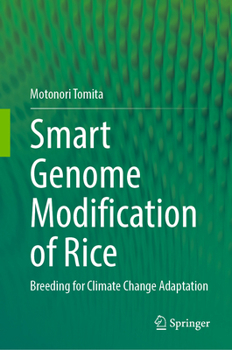
Smart Genome Modification of Rice: Breeding for Climate Change Adaptation
No Customer Reviews

This book presents successful examples of smart genome modification in rice through a unique series of Koshihikari isogenic cultivars developed by the author. Climate change continues to impose severe constraints on rice production worldwide, and these isogenic lines incorporate new genes or gene combinations that prevent lodging caused by typhoons and heavy rains, stabilize yields, and reduce ripening damage under high temperatures. Koshihikari, a leading Japanese japonica cultivar known for its excellent eating quality, serves as the genetic background for these improved lines. The resulting isogenic cultivars hold strong potential for application in agriculture and food-processing industries and may contribute to addressing global food-security challenges. Chapters in this book describe the successive backcrossing strategy used to modify key loci related to regional adaptability and grain-yield potential, and they present multiple Koshihikari isogenic cultivars with altered allelic constitutions at one or two loci. This framework enables precise evaluation of the genetic basis of important agronomic traits. By integrating fundamental genetics with practical breeding methodology, the book serves as a valuable reference for scientists and graduate students in plant genetics, genomics, molecular biology, breeding, and biotechnology, as well as for plant breeders and biotechnologists in universities, research institutes, and seed and seedling companies.
Format:Hardcover
Language:English
ISBN:9819585856
ISBN13:9789819585854
Release Date:May 2026
Publisher:Springer
Length:202 Pages
Related Subjects
Engineering Science Science & Math Science & Scientists Science & Technology TechnologyCustomer Reviews
0 rating
Copyright © 2026 Thriftbooks.com Terms of Use
| Privacy Policy | Do Not
Sell/Share My Personal Information | Cookie Policy | Cookie Preferences | Accessibility Statement
ThriftBooks® and the ThriftBooks® logo are registered trademarks of Thrift Books Global, LLC
ThriftBooks® and the ThriftBooks® logo are registered trademarks of Thrift Books Global, LLC
