


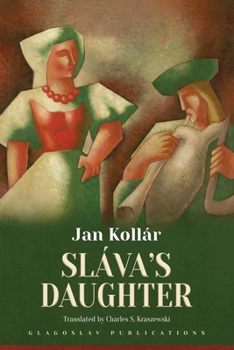
Sláva's Daughter

'O fair Slavenka / You sing no more', laments the twenty-four year old Jan Koll r, wandering the ancient forests of Germany where Slavs once lived: 'Where once the marble walls / of Perun's palace rose on high, the posts / - O, shameful mockery - now prop a byre'. Born in Mosovce, in the Turiec region of what at the time was the Kingdom of Hungary, the Slovak Koll r (1793-1852), was to become one of the great poets of the Romantic period. His masterpiece Sl va's Daughter Sl vy dcera, 1821-1851] is an epic striking both in its breadth, and intent. For although composed during the Czech and Slovak national revival period, the 'nation' that Koll r bewails, praises, and serves in this poem is 'Slavdom'.
Sl va's Daughter is unique in its unrelentingly aspirational Pan-Slavism. Koll r was of the opinion that Czechs, Slovaks, Ukrainians, Poles, Croatians, Russians, and all the rest were merely 'tribes' of the one Slavic nation, and their languages 'dialects' of one great Slavic speech. A Pan-Slav, he worked for ever greater cultural reciprocity between the 'sons of Sl va', which hopefully would lead to their political unification. As poetry, Koll r's masterpiece is a bold and singular work of literature, which combines the style of Petrarch's Il Canzoniere with the prophetic grandeur of Dante Alighieri's Divine Comedy.
The story it tells develops over the space of 645 sonnets arranged into five peripatetic cantos. Along with Koll r's narrator, we follow his donna ideale M na, and Milek, the Slavic Cupid, as they lead us along the banks of Slavic rivers (S la, Vltava, Danube), and those of Slavic Heaven and Hell (Lethe, Acheron) towards the great dawn of Pan-Slavic triumph. Sl va's Daughter, which Glagoslav presents unabridged and annotated in the English translation of Charles S. Kraszewski, is a must read for all those interested in the poetry and history of the European nineteenth century.
Customer Reviews
ThriftBooks ® and the ThriftBooks ® logo are registered trademarks of Thrift Books Global, LLC
